Tuesday, January 15, 2008

Lisa's Take - Wicked (Gregory Maguire)

I'm just really not sure what to write for my review of Wicked. There are a couple of complications surrounding the book: first of all, I love the musical and it severely colors my perception of the book's events, and second of all Wicked is the first non-fantasy that I've read since 100 Years of Solitude, which I still have an outstanding review for because I'm having a hard time finishing it. I believe what the latter problem boils down to is this: I don't read enough literature to consider myself a qualified reviewer of it. Fantasy? I read nothing but, so I could wax poetic on it all day - go on and on about these approaches and those nuances and the other settings. Literature, less so.

So: forgive me if this review is littered with more ineptitude than I usually show.

Right, let's get this rolling the standard way. The full title of the book I'm reviewing does much to sum up the plot – Wicked: The Life and Times of the Wicked Witch of the West. The story starts a little before Elfaba’s birth (Elfaba being the witch’s given name) and follows a number of points of view through the book. All in all, we get about a 40-year picture of the political turmoil in Oz.

At it’s heart, Wicked is a book about the study of Evil, or at least that’s what Maguire claims in his introduction, citing many long conversations with friends to let ideas mull. With that in mind, it’s no wonder that the book is pretty awful, depressing, and upsetting. Especially near the beginning, it’s like Maguire is trying to be as vile as possible in explaining the circumstances surrounding Elfie’s birth. I can see why he did it – the later juxtaposition of “a someone who comes from a rotten past, who everyone assumes is rotten at heart” with “a someone who’s really good at heart, in spite of herself and her upbringing,” is fairly poignant.

It seems like as the book goes on, Maguire gets more caught up in the story and feels less of a need to be repugnant; still, the rest of the story is by no means pretty, and is rife with injustice. Unfortunately, none of the characters had been developed in such a way that the injustices really twinged my heart-strings. You know how it is when you’re reading a book and your chest is tight and your teeth are clenched and you just wish you could yell at the character what they need to do to fix everything? Wicked never inspired that in me, and it should have. If something had been done right, it would have. I’m not sure what that something is… but, the book wanted for it.

Now, as I mentioned before, the book is so very far divergent from the musical – I don’t even know where to begin. The ties between the two only exist as the barest possible grains… names of characters, but not looks or personality or role, for instance. Some barest hints of themes, but without the same implications. Bits of plot misplaced in time and content. And of course the niggling detail that the musical is, at heart, a happy-ending story, while the book is meant to be as depressing and awful as you can conceive. When it comes down to it, I far prefer the musical, but honestly I’d rather just keep the two as separate, non-overlapping, unrelated stories in my head. They’re just too different to merit being called even siblings or cousins, much less the same story.

One last thing – I will say that reading Wicked has made me want to go back and read all of the original Oz books. I’d like to know how many ideas and back-stories Maguire pilfered from L. Frank Baum, and how he changed and morphed interpretations. I have a feeling that some of the conclusions and implications he created were absolutely masterful in their brilliance… but it’s hard to say without reading the original work.

The bottom line here? Again, I profess my suck-i-tude when it comes to reviewing Fine Literature, especially when it comes with so many related works and caveats. Part of me wants to say “if you like the musical, don’t read the book. You’ll hate it.” But part of me also wants to say “you might only appreciate this book if you’ve seen the musical.” In the end, I don’t think I can make a call. The book has merits, it’s well written and engaging – I certainly never got bored – but it’s some pretty rough subject matter. And I’m spent.

Friday, January 11, 2008

Lisa's Take - The Privilege of the Sword (Ellen Kushner)

I’ll just come out and say this one up front: The Privilege of the Sword was decent, but really not as good as I’d been lead to believe. It won a number of awards, and I had several people squee at me about it; perhaps my hopes had just been brought too high. Certainly it was enjoyable, and I tore through it pretty quickly, but I never really got much in the way of emotional attachment to any of the characters, nor did it particularly surprise me.

Hmm. Let me stop and re-think that. I’m a big liar – I should rephrase. I never really got much in the way of emotional attachment to any of the main characters. But I’m getting ahead of myself, let me take a step back and give a plot overview.

Katherine is 15 and her family has lived their whole lives in the shadow of a debt imposed by her crazy uncle, who also happens to be a duke. For Reasons That Become Clear Throughout The Novel, the Mad Duke is miffed with his sister (Katherine’s mother) and does his best to make her married life miserable. Then one day Katherine’s family receives a letter saying that if they would be obliged to send Katherine to the city for 6 months of isolation with her uncle, he would forgive the debt. Sinister overtones set aside, Katherine’s family agrees and ships her off. Turns out the Mad Duke wants to teach Katherine to be a sword fighter, among other things. The novel follows Katherine’s life under the Mad Duke’s tutelage.

Like I said, I never really formulated much attachment with Katherine, though I was fairly impressed by how she was developed throughout the course of the book. I think that if I were a little younger she might have struck more of an emotional chord with me - though I don’t believe young teenagers are really the intended audience for the book, given the rampant sexual situations. But then I was a pretty naïve teenager, so I could be wrong.

While I didn’t ever find myself particularly attached to Katherine, I did get fairly emotionally involved in a couple of the sub-plots. Katherine spends some time studying in a secluded country location with a mysterious teacher – looking back on the book, that certainly was my favorite arc. The tones and feelings of the environment were incredibly well developed and quite poignant, and Mysterious Teacher was one of the best written characters. I found out later the reason he was written so well was likely that he has appeared in another one of her books, but that hardly detracted from my enjoyment.

I think one of the most interesting things about the book was the authors approach to sex. Very, very many fantasy authors tend to “pan to the ceiling” during sex scenes, or omit them completely, or romanticize and flower-ize them. Kushner did none of that – sexuality was just out there in a very natural way. There were girls who liked girls and boys who liked boys, and every combination thereof, and none of it seemed either contrived or abashed. I approve.

Another interesting aspect of The Privilege of the Sword was the way in which the story used a book that Katherine had read – weaving bits and pieces of it in and out of the plotline, revealing different tidbits as they became poignant to the primary tale. I remember very clearly being Katherine’s age and being just as caught up in the books I was reading then, so the approach really resonated with me.

My, that turned out to be quite a lot more text than I was expecting. Having re-visited many of the things about the book that I liked, I feel compelled to revise my evaluation from “decent” to “very good.” It still didn’t quite live up to the expectations that had been set for it, but it was a very enjoyable read. Amusingly, after I finished this book I realized I tried to read another of Kushner’s books a couple of years ago, but put it down after the obligatory 100 pages because it wasn’t holding my attention. Having enjoyed The Privilege of the Sword as much as I did, however, I feel like I might have to go back and give it another try.

Lisa's Take - Temeraire Book 3: Black Powder War (Naomi Novik)

Ok, so it took me a little more than a week to finish the 3rd Temeraire book - I blame the holidays. I fear this review is going to be a little light (in addition to being a little late) as any sort of plot review for a 3rd book is edging into spoiler territory. Also, I'm afraid I've committed one of the smaller sins of book-reading... gluttony. I enjoyed this series so much that I tore through it without leaving enough time for the bits to digest, meaning that plot points and pacing are all mooshed up in my head. It doesn't help that this particular "trilogy," while having fairly distinct endings to each of the books as well as a decent amount of closure, tends to pick of really fast where the previous book left off, making them harder to distinguish when I didn't leave any breather room between them.

Without further ado, the major points I wanted to hit on.

Point 1: Temeraire is not nearly as much as a character in this book. He's there, and he has some ideas, and while he's less whiny in this book than he was in the last one, he's... well, just sort of there, as I said when I started this sentence. I felt like he just wasn't as interesting, didn't have as many entertaining aspects, maybe didn't grow as much as in previous books. Who knows. I just didn't quite get the same connection.

Point 2: The rest of the existing characters aren't nearly as much of a character in this book. Grammatically incorrect, but I was going for resonance with the opening of the previous point. Everyone pretty much behaved the same as before, no surprises, few changes. I just wasn't that upset when characters died or were lost or moved on.

Point 3: This is the first book that seemed rather contrived. I called pretty much all the major plot points hundreds of pages before they happened, which is always a bit of a disappointment. At least this book wasn't just another boat ride.

Now, all those points sound pretty harsh, but let me be clear that this book was still delicious and wonderful and entertaining. The new characters that were introduced were quite good and a nice breath of fresh air to keep things moving along. I profess that I waited a little too long to finish this review, so my brain is starting to lose the details - but the book is definitely worth reading, and I'll be turning to the 4th book in the series to break up some of my harder fantasy very soon.

Wednesday, December 05, 2007

Lisa's Take - Temeraire Book 2: Throne of Jade (Naomi Novik)

Let's see... I finished His Majesty's Dragon Saturday morning, then that evening went out and bought the next 3 books. I would have finished Throne of Jade at lunch Tuesday, but I had to cut my lunch time in half, which meant I had 30 niggling pages hanging on that had to be pushed until dinner time. Still, I finished the book in under three days - I trust you take that as an adequate indicator of how drawn into the world I am.

I will refrain from re-gushing over the same details of the world and the book as I did in my review of book 1; if you haven't read that review yet, I suggest you start there, and then try this one on for size. Throne of Jade does something fairly brilliant in the realm of fantasy, and instead of doing the same thing in the same setting over again, it takes a quite new tack. When it comes to light that Temeraire is a rare Chinese celestial dragon, China is displeased and demands he be brought before the emperror. So, instead of rehashing the same ideas as the first book, we get a whole new setting and quite a number of new, interesting topics and developments. There's a lot more political intrigue this time around and fewer of the heart-in-throat aerial battles. Regardless, the book stays true to the underlying themes from the first book.

That said, this time around I'm ready to knit pick a bit. Two thirds of this book was occupied in telling about the 8-month boat trip from England to China. There was a lot of plot happening, and a number of pertinent points were brought up... but it started to drag after a while. It could be argued that this was the author's intention, which is to say that she really wanted to impress the doldrums of the journey, but especially in this case that seems a thin excuse. I would much rather she'd kept it a bit shorter and then devoted more of the book to the happenings in China. The latter part of the action seemed a bit squished in and hurried, as though she were rushing to fit everything in before she hit her word-count limit.

Near the end of the book I also found a couple of moments where it seems like characters acted... well, out of character. Especially Temeraire's behavior made me do a couple of double takes, as though Novik didn't do a good enough job justifying what caused his reactions. Sure, he's supposed to be a finicky belligerent teenager (in essence) during this book, but that doesn't mean he should be jarringly unpredictable.

Aaaand, that's all I've got. I had to work pretty hard just to come up with those two critiques, truth be told. I suspect if I hadn't been reading with a critical eye, or if I hadn't read it directly back-to-back with the previous book, I would have had nothing to complain about at all. Once again I give this book and it's predecessor a resounding thumbs up - absolutely a must read for newly released fantasy. I suspect I'll have a review of book three finished within a week, at the rate I've been going.

Lisa's Take - Temeraire Book 1: His Majesty's Dragon (Naomi Novik)

I don't know that I could possibly start this review off with sufficient exuberance - I feel like I'd need more exclamation marks, made up words and capital letters than can possibly be healthy or acceptable in a literary blog. Instead I'll just keep it to this: I absolutely could not be happier with His Majesty's Dragon. Less than 2 days after I finished it, I'm already about 30 pages from the end of book 2; when I went to the book store I bought books 2-4 immediately, not to mention the girlish squeal of glee that escaped me when I discovered that there was more than just the trilogy I was expecting. I am entirely thrilled.

I'm trying to recall if I've read any Dragonly literature since my Ann McCaffrey kick back in high school. Back during my freshman year I plowed through every single Dragonrider of Pern book in a matter of a few weeks. I suppose my last book (Guards! Guards!) had some dragon-bits, but it was at least in part incidental to the story, rather than the main focus. Hmm, I hadn't realized it had been so long...

Tangent aside, this book is simply fantastic. The basic premise is straightforward: take the Napoleonic Wars, and imagine that all of the countries possess, in addition to the traditional military and navy, an aerial division of manned dragons. I'm truly impressed by how skillfully she inserted dragons into the history, the change really is about as seamless as you can get. As for the plot itself, the book follows Will Laurence, a naval captain turned aviator. When his crew captures a French vessel that has an egg on board, they can't make it back to port before the egg hatches. When the dragon emerges it attaches itself to Laurence, who names it (Temeraire, if you hadn't guessed) and cares for it in spite of knowing being drafted by the aviators will be the end of his naval career.

Aside from the exceptionally interesting premise, there are a few other noteworthy things about this book. First and foremost: the characterizations are absolutely stunning. Both Laurence and Temeraire are especially vivid and convincing, and each of them develop richly throughout the story. The entire cast of supporting characters are also well developed and inspire a great amount of emotion. On top of these points, the plot is excellent and engaging - it reads like candy and inspires all sorts of appropriate emotions while not being too predictable, and certainly not over-done. The dialog is excellent and the story is historically accurate; I can't even begin to imagine how much research she must have done.

As an amusing, if irrelevant, site note: Naomi Novik is massively adorable. She's a total geek - did her grad studies in Computer Science, was part of the design or dev team for a Neverwinter Nights release, and is in general googley-eyed and cute. Clearly more authors need to be of a geeky nature and personally pleasing to me!

The bottom line: get this book and devour the hell out of it. It's too good to ignore - just be prepared to immediately go invest in the sequels.

Lisa's Take - Guards! Guards! (Terry Pratchett)

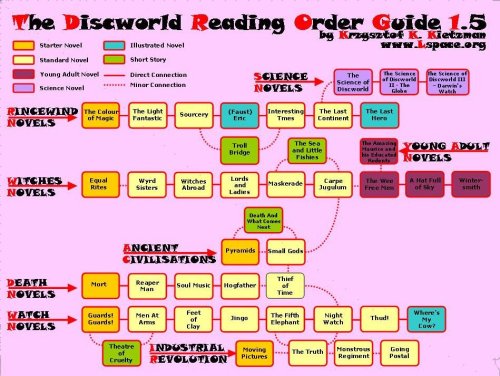
tIf there's nothing quite as bad as having high hopes for a book and having them dashed, conversely there must be nothing quite as nice as having high hopes for a book and having them fulfilled. I got my first taste of Prachett about 8 years ago when I picked up The Color of Magic, Pratchett's first Discworld novel. I was mildly entertained, but it wasn't spectacular and just didn't quite deliver, so I never really kept going with the series. Finally after another 4 or 5 years of badgering by various individuals, I decided to give the Discworld novels a second try, this time starting with a different story thread - the Guards thread rather than the Rincewind thread. I was assured that the Guards thread is some of his best work, and that he had a few dozen books under his belt by the time he started it, so there would be no more New Writer Blunders.

Guards! Guards! (I love writing out that title, I get to be so exclamatory) follows the mishaps and adventures of 4 nightwatch guardsmen who are, respectively, a Drunk, a Sleaze, a Blustery Coward, and a Definitely-Not-Long-Lost-King. When Dark Forces connive to infest the city with dragons, it's up to the aforementioned quartet to get to the bottom of the mystery. Really there's not a huge amount of story there, so I'll leave my summary at that to avoid spoilers.

Basically everything about this book was spot on. It had an interesting story that at first glance seemed predictable, but then turned out not to be. It had solid entertaining characters that actually *gasp!* developed via the plot line. It had excellent, witty dialog that got quite a number of chuckles out of me, particularly as many instances struck a Monty Python-esque chord with their pacing and delivery. Finally there was a healthy dose of intrigue, good guys in black, bad guys in white, clever and daring escapes, incredulous romances, and entertaining footnotes. Have I mentioned I'm a sucker for footnotes?

Anyway, the bottom line is a resounding thumbs up for this book - it's most certainly worth the read, and I know I'll be continuing to devour the rest of the books in this storyline. Seeing as how I'm nearly out of Dresden File books, I think these will serve nicely to break up other more serious fantasy.

Tuesday, November 13, 2007

Lisa's Take - Name of the Wind: Day One of The Kingkiller Chronicle (Patrick Rothfuss)

Looking back over the last month or so of reviews, there has been a whole lot of mediocre-to-negative. My review of The Blade Itself was particularly nasty - amusingly JD finds the dichotomy between my review of the book and the rating on amazon so great that he's decided to hold off on reading my review until he can digest the book for himself and see if it's really that bad, or if I let my knit picks get the better of me. Hopefully he'll come to similar conclusions and not take my credibility as a reviewer down -too- many notches.

Regardless, I decided that after so many bad reviews I'd better pick something I liked to review next. I thought about waiting until I finished Prachett's "Guards! Guards!" to write my next review (as that's basically guaranteed to be a glowing report) but then Pat Rothfuss friended me on Facebook and inspired me to get off my lazy toosh and write a review of Name of the Wind. Really this book deserved a review as soon as I finished it - but like I mentioned in the previous sentence, "Lazy Toosh." So, let me remedy that here.

Name of the Wind is a story told in the first person by an gentleman named Kvothe as he recounts his history and the events leading up to Some Mysterious Huge Thing that sent him into hiding in a remote, rarely frequented town. All in all, Kvothe recounts 14 or so years of his childhood in one day, thus how Name of the Wind is "Day One of the Kingkiller Chronicles." I'm not quite sure why, but I found this storytelling style very interesting, and it added a nice flare that helped spice up the story.

As for the story that Kvothe relates, it falls loosely into two categories: Kvothe's life before going to Magic School, and Kvothe's life at Magic School. I'm going to begin with my review of that second half, because as you might be able to guess from my (slightly belittling) terminology, that was my less favorite part of the book. Over all the book definitely gets a thumbs up, so I'd like to end it on an up note, rather than with criticism - thus let me get the bad out of the way early.

The trouble with the second half of this book (other than the fact that it dragged a bit) is that... it had all been done before. Many times. Especially if you've ever read Mercedes Lackey (who is kind of the gateway-drug into fantasy for teenage girls). Kvothe's story is just kind of the generic: kid goes to school and is so amazingly brilliant that even though he's young he excels everywhere, but of course there are both certain professors and students that have it out for him because he's so amazing. Unfairness and angst ensue interspersed with other accomplishments and triumphs. Heh, screw Mercedes Lackey - when I put it that way it kind of sounds like Ender's Game, too. Like I said, could have been a little more inspired. That said, the characterizations, dialog and interactions were very interesting, and the magic system original and intriguing. Also - the first half of the book was really excellent...

...So let me jump back to the beginning. The first half of the book is Kvothe relating his childhood before school. There was absolutely nothing hackneyed, predictable, or over-done about this part of the book. It was very fresh and interesting - not to mention I was very sympathetic to the characters very quickly. I had read maybe a couple of chapters before I turned to JD and said "Gah, this book is going to be trouble... I'm already emotionally involved." Particularly noteworthy was how incredibly well written Kvothe's parents were. I know - that's kind of an odd thing to comment on, but I think it might have been the most impressive thing about the book. I'm not sure I've ever read a happy pair of lovers done so damn well... it's just so easy to miss the mark when writing something to involved and emotional end delicate, but Patrick Rothfuss got it spot on. Also worth mentioning was the introduction of some intriguing and elusive Bad Guys, a fantastically developed Mentor, and the first peek into the interesting magic theory I mentioned above.

Really the bottom line here is this: over all, Name of the Wind is an excellent book. I had a gripe or two, but when it comes right down to it I very much enjoyed it, and I'm eagerly anticipating the sequel.

Friday, November 09, 2007

Lisa's Take - The Blade Itself: First Law Book One (Joe Abercrombie)

Picture: A book with a cover that looks like worn, blood spattered parchment. Intriguing to say the least. Now imagine you pick up said Intriguing Tome and turn it over to see that the top comment is by Scott Lynch - who happens to be your Favorite Author Of The Moment. If you were Lisa in this situation you'd let out your patented "book squeal" (which is a hushed combination of a surprised utterance and thrilled giggling) and drop said book onto your (already alarmingly large) pile of books your about to purchase. If you have a JD present, he would at least have the presence of mind to read the back and flip the book open to check and make sure this is a Good Idea, but seeing a chapter entitled "Never Bet Against a Magus" would remove any lingering qualms.

This sounds ideal, yes?

Sadly, not so much. I'm afraid I've had my book choosing skills completely questioned to the point that I may never be able to select a new book without thorough research again. Okay, that's an exaggeration - but damn there could be no bigger let down than my self-imposed hype of this book compared to what it delivered. This is by far the most disappointing book I read this year - not only because I had such high hopes, but also just because it was Just Bad. Yes, with a capital J and B. I did something with this book that I haven't done since I read the first Wheel of Time book. When I read that one I dog-eared the bottom corner of every page that was a flagrant fantasy cliche or LoTR rip-off. This time around I dog-eared every page that had a plot or character inconsistency, PoV screwup, or bit of text that just made me laugh with incredulity. Yeah, it was that awful.

Let's start with the plot. I can't give you a plot summary, because, well... there wasn't really one. This book had no beginning, middle, and end. It was a mishmash of badly done, interleaved Point of View snippets that seemed to do a lot of... setting up, maybe? But they never really went anywhere. Even once the characters started converging there was just this sense of "yup, they sure did overlap. Didn't see -that- coming. No sir." There's a storyline following some unrest with the barbarians in the north. There's the escaped slave and overlord uprisings in the south. There's the country stuck in the middle that has some (laughable) political intrigue, a contest to Make A Champion (TM), and denial about impending wars. Finally there's a bit of Mandatory Magical Elements so that the book can officially qualify as fantasy. Eventually these plots interleave a bit. Mostly they just get told separately, and you can see the obvious and clearly defined ways in which they're going to impact each other.

Let's move on now to talk about the characters. Like I mentioned above, Mr. Abercrombie tried to write this book through character PoVs. He... did not pull this off well. He starts off with 3 major PoVs, then adds a 4th about half way through. That's ok. But then mixed in he (accidentally? I should hope not intentionally) would have random characters that had never had a PoV before pop in with a few pages or observations. That was badly done and made the whole plot setup feel very.... jumpy. Then, to make matters worse, in the second half of the book where characters stopped overlapping he did a fairly awful job of keeping PoVs well separated. At one point I had to stop and re-read a couple of pages because he jumped without warning from one PoV to another in the middle of some action and didn't make it clear, so I was left going "wait, why would he think that? He doesn't even know.... Oh." The worst part is that all of this could have been remedied with better editing. Someone needed to read this through and pay closer attention to "whose head we're currently in, where they are, what they know, and who they're interacting with."

Ok, PoV complaints are delineated. Now we can talk about character stereotypes, inconsistencies and cliches! I actually just made a list of all the characters I wanted to touch on, and it got a little lengthy. Forgive me for the places where I don't use names, many of them already escape me and I don't have the book immediately handy.

First we have our main PoV characters:

-Glokta of the 4 has the most potential to be interesting - he was the king's darling who was tortured and mutilated in the last war. Now he has a broken and rebellious body and works in the Inquisition as a Torturer because no other government branch will have him. He's at least marginally entertaining as he's one Jaded Motherfucker... unfortunately the whole Torturer thing feel like it's pulled route from Gene Wolfe's Book of the New Sun, which takes some of the creative shine off of it.
-Jezal is a military officer. He's an egotistical prick. He (predictably) subscribes to the Rich Common Belief that Poor People Without Noble Lineage shouldn't be allowed to be officers, and looks down on anyone who fits that bill appropriately. Oh, except that he then (predictably) falls in love with the commoner sister of his commander (where said commander got to be a commander by winning the Make A Champion (TM) contest mentioned above). He rails a lot against love but is (predictably) subject to that Cruel Mistress' whims. Oh, he's training to win this year's Make A Chamption (TM) contest to make his father proud and win recognition.
-Logen is a Northern Brute of a man. He was a champion in the north and has seen many battles, as the scars that disfigure his face and body prove. But underneath that brutish exterior is a tender and remorseful (but yet) intelligent and calculating mind.
-Ferro is an escaped slave who's out for VENGEANCE AGAINST THE WORLD! She's as mean and vicious as you could possibly imagine.

Next we have the two characters who aren't really PoV characters, but who have a couple of PoV moments erroneously snuck in:
-Major West: Jezal's commander. He was a commoner who won the Make A Champion Contest and won his command. Of course no one respects him, but he's a fine gentleman; enterprising, honorable, and of the highest moral values.
-Ardee West: West's younger sister who has no use for the pomp and rules of high society, and yet rails against the confines of being a commoner. Also she's made of past scandal, is a seducer of men and a huge lush. Of all the characters so far she manages to be at least mildly original and interesting. Too bad she's not a real PoV character.
-The Dogman became the leader of Logen's band when Logen was thought dead. The Dogman himself is interesting, but the rest of his crew is inconsistent - they are at first portrayed as the worst kind of scum, entirely without feelings or morality. Bad Men all around. But then they get going on this whole moral and honor thing... and it just doesn't quite grep.

Finally we have the non PoV characters
-Bayaz is every stereotype you've ever heard of a wizard (that doesn't look like a wizard). Does Teh Magicks, follows his own set of rules, is prone to hidden agendas and flashes of anger - all while trying to come off as a guiding and grandfatherly influence.
-As for the rest of the minor characters, there's the King who is slovenly and uninvolved, his sons of whom one follows the king's footsteps and one is of upstanding moral character, the princess betrothed who hates her fiance, the Higher Ups in The Inquisition who are cold and schemey, the King's aid who's trying to steal the throne out from under him, and the Dude who Jezal eventially fights in Make A Champion contest who is clearly a heartless brute but then gracefully concedes the win and even lifts Jezal up to the world!! Note that I went back and removed the 7 or so instances of "predictably" from the previous sentence. There is literally not a single character here that is unique, new, or inspired. There's ONE Inquisitor that has a few lines of involvement who entertained me for being cheerfully schemy, but he got depressingly little screen time.

I promise I'm not hyping up these descriptions (with the exception of a few "predictable" asides). They really are just that hackneyed. In a lot of the cases it's like he came up with a character and then went "that's to plain and overdone, let me spice it up!" But then in adding that spice just made the character that much more cliched. Then top everything off with a healthy dose of "not sticking to the characterization I put forth" and... there's not much salvaging to be done.

That wraps up the character gripes, the plot gripes, and the consistency gripes - but I have one more thing to complain about. This is actually the first problem I had with the book, before all the other flaws came to light. It's silly but it bugged me a lot, right from the beginning. All of Mr. Abercrombie's characters "speak" their guttural utterances. "Aaaaargh!" or "Oof!" or "Uh." or "Er..." are very common conversational lines. Now, there are cases in which this sort of dialog can be humorous - for instance when Jezal has his first conversation with Ardee and she's commenting on his (not so) renowned wit - and all he can come up with for a reply is "Er..." That situation's ok and if it's done just right can even be amusing. But when some dude is getting tortured and you're obviously trying to build a very intense, graphic and violent air to the scene? It's not appropriate to have him say "aaaargh!" after each torturous action. You might try "a hoarse shout of pain" or perhaps a "bloody gurgling cough" but "aaaargh!" over and over just doesn't cut it unless you're specifically trying to go for comic relief. Who knows, maybe if this first little knit-pick hadn't set me on edge I wouldn't have been so hard on the rest of the book... but then again, maybe not.

Well, with all of that text I hardly feel like I need a closing paragraph, but I suppose in good form I should wrap things up explicitly. Don't waste your money on this book. Don't waste the effort required to borrow it from me, or the brain power necessary to slog your way through it. Hell, probably just reading this review was more time than you ever needed to dedicate to The Blade Itself. Really any good, dedicated fantasy reader would skip this review all together and dedicate the 15 minutes you save to emailing Scott Lynch and ask him why he so maliciously deceived me. I suppose I should have thought of that an hour ago!

Monday, October 22, 2007

Lisa's Take: The Black Jewels Trilogy (Anne Bishop)

(In a clucking tone of voice) TRIIIIIPE tripetripetripetripe. Tripe.

By all that's holy, I really don't know how I finished this trilogy of books. I think perhaps it was only for the feeling of conquest that comes with completing an exceptionally thick volume - which this certainly qualified as, with the trilogy bound into one book. Surely there were some redeeming features to be had, but I'm having the worst time calling them to mind now. When you get right down to it the prose was dull and uninspired, the characters didn't even approach anything resembling original, compelling or consistent, and the plot tried SO hard to be full on intrigue, emotion, and convolutions... but was really just straightforward and predictable. Also made of holes. Perhaps the only thing I can say for the books is that the universe and premise behind it was original and at least marginally interesting. If I stretch really hard there might have been 3 lines of dialog that got something resembling a chuckle out of me. At least said dull and uninspired prose was digestible enough to keep the words flowing. That's as much praise as I can manage.

This is the part where I classically would type "That said, you might still consider this book if...." but no. Not this time. Maybe, MAYBE if you're a 16 year old girl who reads nothing but Mercedes Lackey or Laurell K. Hamilton you might find this trilogy worthwhile. Personally, I can muster nothing but scorn and scathing words, so I will leave this review laconic - which is to say, I will end it right here. How's that for a bad review of a bad book?

Lisa's Take: The Kite Runner by Khaled Hosseini

I know, this is an odd break from my usual diet of fantasy, sci-fi, fantasy, and more fantasy, isn't it? I blame boredom - I was stuck immobile while a few other people investigated a corn maze, so I rooted around in their supply of satchels and purses until I came across something to keep me entertained. I found The Kite Runner, which I had no idea was such a well known and acclaimed work (movie is in production, and held up with all sorts of controversy). Shows how much attention I pay to the Straight Fiction Genre as a whole.

Anyway, I can understand how The Kite Runner has garnered so much acclaim. It's one of those books that... pretty much can't help but get good reviews and recognition, much like any movie about (for instance) 9-11. The problem is that I can't decide whether it's only good because it's so startling, or if it's actually good in its own right. I suppose I'll start with a quick summary and then go from there.

Kite runner is a story about a man named Amir. The plot follows him through his childhood, cataloging the betrayals he perpetrates and the path that his life follows afterwards as he comes to grip with living as a coward and eventually seeks redemption. It begins in Afghanistan in the 70s and the political unrest there is both a reflection and a backdrop for the whole story.

That's a fairly paltry summary, but to be honest there's just not -that- much content I can summarize without getting spoilerific, so I'll leave it at that. The day I picked up Kite Runner I read about 40 pages, and it was good enough to keep me hooked and legitimately borrow the book. The images it evoked were both clear an engaging, and I found myself quite drawn into the image the author painted of childhood in the summer. Of course this just made the impending turning of the plot for the worse that much more painful - I was in quite an awful mood the day the book got depressing, and it was really very effecting.

That said, the author did a few things that really prodded my pet-peeve button and did a lot to detract from the story. Gripe number one was the constant and flagrant overuse of "Little did he know." It wasn't always phrased that way, but I swear to god if I had to hear the main character say "I didn't know then, but..." one more time, I was going to punch someone. Gripe number two was that the whole thing was just too... tidy. Not in the literal sense (as there was violence and gore enough to offend even the most staunch sensibilities) but in the sense that everything just sort of worked out and fit together juuuuust so. Old childhood nemesis cropping up at exactly the expected moment, that sort of thing. While the first half of the book pretty much took me, if not by surprise, without a sense of "oh, here it comes," the second half of the book was just one instance after another of "ah, I see, now this is going to happen, and then that, and the timing will go just so." Right at the very end I thought the author might shake things up and tarnish the obvious perfection that was impending... but, he didn't. Not really.

That said - The Kite Runner is still one of those books that can't get bad reviews. It's well written enough that you can get over it's faults, glaring though they are to any but the most pedestrian of readers, and the story and events in it are controversial enough that you can't bad mouth them without being called an ass. What a way to gain acclaim! I guess in the end I'll say it's a good book - but it certainly gets a lot more credit than it's truly due. Still, it's worth the read.

Monday, October 08, 2007

Lisa’s Take – Vellum (Hal Duncan)

There is, perhaps, nothing in the world more infuriating than a book that could just almost be absolutely incredible… but, rather than pull through and be remarkable, manages instead to be awful, painful, and frustrating. Vellum is the first book I’ve ever read that quite fits this bill, truth be told – the occasional novel might be dull with brilliant flashes, or excellent with bad aspects that bring it down, but nothing quite like this. For my first trick, I will attempt a plot summary. I’m wildly torn between saying that there’s just too much to summarize, that the paths and meanderings of the text are too divergent to condense into a few sentences… versus saying that there’s not enough there to make a summary out of – the story too thin, the characters too inconsistent. Still, I’ll try.

There’s a war coming between heaven and hell, and the angels that (brutally) run heaven are trying to make sure that all the unkin (fancy name for more angels) in the world have chosen a side. They don’t really care which side the unkin choose, just that every person is either for heaven or against it. Sounds more or less straightforward; you’ve got 6 or 7 characters fulfilling various roles in this fairly tidy little notion.

Except that then you’ve got the Vellum, too.

The Vellum is this concept of… hmm. I guess the closest analog in sci-fi/fantasy would be the concept of parallel universes – universes in which every scenario, every situation, every development of a character. This is also pretty straightforward, except that then Mr. Duncan introduces the idea of Time as a Three Dimensional Beast – so every few chapters put your characters in a blender, give it a whirl and pour out a new smoothie of relationships, roles fulfilled, setting, genre, and time period. Oh, and eventually there’s some sentient nano-tech. Had to throw that in there.

Now, I still think Vellum could have worked out, in spite of the time- and role-bending. Ducan has some seriously awesome ideas… classic fantasy transposed over a modern world, alternate histories for both world wars, hard cyberpunk and Gaijin Ninjas, ancient Sumerian; the list really just goes on and on. But instead of just writing the damn novel, the author chose to break everything up into third- and half-page chunks, mixing his ideas, his time periods, metaphors… so that instead of the smooth, bendable expanse of vellum that he preaches, you’ve basically got a wadded up, crinkled piece of paper. I literally had to sit down and force myself to read, because there was zero in the way of flow or continuity. You couldn’t keep a handle on the characters long enough to get attached to them or know them. Say you liked one of his worlds and ideas? Too bad! It’s gone before you could do more than start to form a vague inkling of appreciation.

I could go on with the ranting, but I’ll desist before I get incoherent in my frustration. The bottom line? Reading Vellum was thoroughly infuriating and unenjoyable… and then just to ice the cake there’s no end, no winding down – the book just stops, presumably so that the sequel (Ink) can pick up. Too bad that I won’t be picking it up.

Thursday, September 20, 2007

JD's Take: Homeland (R. A. Salvadore)

I've been wrestling for months with the desire to read cheap, pulpy, horrid, serialized fantasy or science fiction. Based on someone else's intellectual property if at all possible. I finally caved when I discovered a copy of Homeland by the oft-reviled R.A. Salvatore sitting on our shelves looking forlorn.

For those of you unfamiliar with this little piece of geek history, this book was the introduction of the character Drizzt. Still nothing? Okay, fine. Drizzt is a Drow Elf (or dark elf. The evil kind) who has a Good Heart, Two Scimitars, and a Pet Leopard. He rebels against the evil society he is brought up in (aided by the fact that he is So Much Cooler than anybody else) and becomes a great hero of the world. Sound like a hackneyed backstory from roleplaying session? An overused D&D cliche? It is, and this book is the reason for that.

So. I read it. Let me just give you a couple of impressions.

1) The spine of the book does *not* list the author of the book. There isn't room. See they needed the title, the name of the story cycle (The Dark Elf Trilogy. Very catchy) the book number (1!) and of course... the Forgotten Realms logo. Oh, and the TSR logo. And the publisher's logo.

2) So near the end of the first or second chapter I was forced to stop and step back from the book. On the two page spread I was looking at, 11 out of 14 paragraphs started with the word 'Zak'. Seriously. That's some quality writing.

3) The word Drow is *never* used without being followed by the word Elf or Elves. That's at least once a page, and never is it used by itself. It's absurd. Surely by page 50 I've figured out that the Drow are a kind of elf!

4) The Drow are Chaotic as a race. Which explains their rigidly lawful theocracy. Actually, I can't blame this one on Salvatore... stupid TSR.

Having said that, I almost wrote "but it's still a fun read" out of habit. But it really isn't. The basic plot arc is Drizzt is born --> Drizzt grows up to be a Hardcore Badass who excels at everything he touches and has a heart of pure gold --> Drizzt leaves the city with his pet Leopard. At no point do you doubt his safety. His mentor dies (oh shits! Spoiler) which any reader could have predicted at page 30. He is dutifully sad/enraged. His rivals fall before him (but he feels bad about it) and he leaves because he refused to conform to the evil ways of the evil society of his evil race. His sense of Good and Honor blossom despite the fact that he was at NO POINT exposed to these ideas.

Spare me. The good news is, it's a quick read. And you can't pick up this novel with high expectations, so you aren't likely to be terribly disappointed. That's about all the good I can wring from it. I'd read more but I'm pretty certain I get the gist of the REST OF HIS LIFE. For fun, I'll predict some key events:

  • Drizzt meets other elves. Turns out, They Aren't Evil.
  • Drizzt is outcast (oh! the title of the second book!) from Good society because of racism! Racism is bad!
  • Drizzt is framed for the vicious murder of a school filled with orphans, which he was only trying to protect! Poor Drizzt!
  • Drizzt gains the respect of the Elven Community!
  • Drizzt kills Lloth, the spider-queen-god of the Drow Elves
  • Drizzt, his Pet Leopard, and his New Girlfriend(I'm guessing a wood cleric)/Brother In Arms (a nobleman on a quest of self discovery. Probably a wizard/fighter) die bravely in battle. But they get better. Repeatedly (This happened (twice) to the damn cat in the first book alone!).
  • Drizzt mournfully sees the downfall of his race. He is very conflicted about it.
  • Actually, Drizzt spends an unhealthy amount of time feeling sorry for himself. Then he kills shit and it makes him feel better. Or sets off the next bout of self-loathing.


I wonder if Alien fiction is any better? Or maybe Warhammer?

Lisa's Take: Gil's All Fright Diner (A. Lee Martinez)

I’d like to start this review by noting that I typoed Mr. Martinez’s name twice as A. Leet Martinez. This mistake can certainly be attributed to the fact that’s he’s one hell of an awesome dude, as much as it can be blamed on my slow and under-caffeinated fingers. But that’s neither here nor there, I suppose…

Gil’s All Fright Diner is Martinez’s first book, released in 2005, and while it’s marginally less polished than his more recent 2 releases, it’s still a fantastically fun read. The story follows Duke, the werewolf, and Earl, the vampire, a couple of rednecks who happen to be in the right town at the wrong time. The word “hellmouth” springs to mind, for you Buffy fans out there – but I’ll refrain from saying more, as the book is pretty short and I wouldn’t want to spoil. Throw in a devious and nubile teenage Japanese seductress, an overly compassionate ghost and Loretta the Diner Cook, and you have a massively entertaining idiosyncratic rollick. That’s right, rollick as a verb. I said it.

What else is there to say? Obviously the premise is as outrageous as all of Martinez’s other books, and just as laugh worthy. I will mention that, much like his other works, he has a tendency to grow more serious (and more gory) towards the end of the book. That said, it’s still an excellent read, cover to cover – and damn if the pages in between don’t fly by quickly. I knocked this one out in maaaybe 5 hours total. DEEEElicious!

Finally, I’d like to make a quick note of my Great Approval for authors that release a book every year. A good book, at that. Authors whose names are subsets of Mr. Martinez’s could learn a thing or two about this. And now go! Make for the Leet reading!

Monday, May 21, 2007

Lisa’s Take - The Great Book of Amber (Roger Zelazny)

Warning: This is Not A Book. I know it’s 1258 pages long, and claims to be “all of the chronicles of Amber now in one volume.” But seriously. It’s lying to you.

With that said, this collection is worth a read, so long as you don’t mind a little frustration. Zelazny spins some damn good tales, even if he can’t actually write a book. There are actually two story arcs in here: the first follows Corwin, a man who wakes up in a mental hospital with no memory. He bluffs his way out and as events unfold it turns out he’s a prince of Amber – where Amber is the real center of the universe, and every other reality (including Earth as we know it) is a Shadow. There are some really entertaining ideas here… I wish I’d consumed these books as a kid, because while it would have been a challenge, my imagination would have had a field day. Anyway, we follow Corwin through the various power struggles and intrigue involved in the throne’s succession. This comprises the first 5 (or 6?) books in the compilation.

The second arc follows a character named Merlin (whose history I won’t reveal as it rather involves some major plot points). Come to think of it I can’t really describe much about Merlin’s arc at all without giving a lot away. So I suppose I’ll just suffice to say that the second half is about Merlin and his adventures – which involve more Amberian politics, many of Corwin’s counterparts, and themes both more and less mundane than the first 5 books.

The only problem with the whole thing is that each book… well, isn’t even remotely a book. Sure there’s some ramp up that involves rehashing Everything Up To This Point, and there’s build up and climax… but generally they just climax into a cliff hanger. Then you turn the page and you’re on the next book. Really this is ok with everything bound in one volume, because it’s easy enough to ignore. The REAL problem is that the same thing can be said for the final book. It just leaves off, exactly the same as all the previous books. Bugger. The worst part is you can tell from the feel of things there that Zelazny was probably planning a whole ‘nother story arc… but the bastard kicked the bucket. The nerve of some authors, eh?

But yeah - I’d say The Great Book of Amber is worth reading. It’s definitely engaging, interesting, and has excellent characters. It also got me laughing aloud a number of times, which is always a good sign. Just two suggestions: read this book with something breaking up the middle. I did it all in a couple-week blitz and it was just too much. I’d suggest reading the Corwin arc, then giving it a short break. And secondly: be prepared to not have everything wrapped up. There’s nothing for it.

Saturday, December 16, 2006

JD's Take: The Lies of Locke Lamora (Scott Lynch)

Dane Cook says that there are two things guys want more than sex: to be in a heist, and a monkey. He's a comedian, ergo he jokes, but I think he's on to something here. That something is the inherent goodness of a good heist. A caper. A con. A scheme cleverly implemented to bilk some poor sap with too much money out of a large portion of that money. I don't even need to list for you the movies that have been made based on how Good a fine caper is, or the tremendous amount of literature dedicated to depicting ever more clever schemes. You know these things because you realize on a deep level that heisting is Awesome.

You see where I'm going with this? Scott Lynch did the unthinkable with The Lies of Locke Lamora. He wrote a con game novel in a fantasy setting. Probably this has been done before. But there are a number of reasons why this time it actually matters. I will list them, list wise, thusly:
1) He doesn't just use the fantasy setting as a backdrop. The characters are involved with it, it is independently interesting (though not, I admit, groundbreaking) and well developed. It has unique features that play into the story, magic that actually effects the plot, and even decent politics. The religion is also fucking sweet. I approve.

2) Proficient and prolific cussing. The characters cuss like drunken sailors on leave. Or, to put it another way, like normal human beings would in the same situations.

3) Clever writing, complete with >1 actual, truly, surprising moment. I'm not talking, "if I blinded myself to the obvious in an effort to go along with things I'd be surprised by that!". I'm talking, holy-shit-i-can't-believe-that-shit surprises. Maybe I'm just dense, but everybody else seemed to react the same way, so maybe not. Kudos Mr. Lynch.

4) The reader does not have his intelligence doubted. Many authors, when writing a clever twist down, seem to chuckle to themselves, saying: "mwahahaha. My readers will never see THIS coming" and then wait for the (*yawn*) clever reveal in another 100 pages. Mr. Lynch understands that readers are clever monkeys, and can see through the ruses of his characters. Consequently, he doesn't hold off just telling us the truth. Looking back, this may be a clever trick to catch us off guard for the aforementioned surprises.

So we have on our hands a well written, fun, exciting, suspenseful, clever fantasy novel with an interesting world, fascinating characters who cuss a lot, and a writer capable of surprising me. AND it's a book about an elaborate and clever con game to bilk a rich politico out of his money. AND it's written to an intelligent audience, while still managing to surprise.

So why do I look so glum?

I have to wait until March-ish for the sequel. The good news is that the publisher seems to have some idea what a find it has in Scott Lynch and has him scheduled for a grueling schedule of books, novelettes, and short stories. He's signed up for, I dunno, seven more books or so. This Will Not Suck. Ooh! He's also young, I'd say 25ish, which means many more book-rearing years in him yet.

I wonder if he knows about the monkeys?

Wednesday, December 13, 2006

Lisa's Take: Magic Study (Maria V. Snyder)

There’s not a whole lot to this book, so it gets just a quickie.

You know Mercedes Lackey? Think that, but a little better, with more enjoyable characters, slightly adult-ier themes, and no goddamn telepathic animals.

Again, this is the second book in a series (what is up with me and that?) and the general idea is that our Heroine returns to her country of birth to learn how to control the magic inherent to her family line. She misses home, stuff happens, she helps people out and starts to come to grips with her heritage. Yay.

Aaaand that’s about it. It’s a good book, and entertaining. Not quite as original and engaging as the first, but still tasty, and easily consumable in just a few hours.

General thumbs-upness.

Wednesday, November 01, 2006

Lisa's Take: Time Dancers - The Meq vol. 2 (Steve Cash)

So about a year ago I picked up the first book of The Meq and was fairly entranced. Ate through the whole thing in a few days. The premise is fairly simple: there is a race of people called Meq, who when they reach 12 years old, stop aging physically. They can stay forever 12 years old until they meet their one pre-destined true love (a love who could have been waiting thousands of years) at which point they can continue waiting or their can “cross over” and mature, in order to continue the Meq bloodline. In about a hundred years there is to be a ceremony of great importance – but none of the Meq really know what it is or what it signifies or what happens – just that it’s very pivotal.

The main character is Zianno (Z for short) who learns of his Meq heritage when his parents die. We follow Z as he figured out what it means to be Meq and slowly is initiated into the very small Meq society, meeting other Meq, learning about Meq-friendly contacts, and assimilating their customs. It takes place over a 40-or-so year period from the late 1800s through the 19-teens. The story is continued in book two, where Z and Co. travel the world looking for keys and tools and information pertaining to Aforementioned Ceremony, as well as battling a renegade Meq assassin. The second book ranges from where the first left off up until World War II.

What makes these books nifty? In general they have pretty solid, engaging, well rounded characters. Moreover, you get an interesting take on world events and different countries at various points through the last couple hundred of years. The first book really was great – I was quite entertained and emotionally invested. The second book though? A little less so. Don’t get me wrong, it was still pretty good and a pleasure to eat through (again with the finishing quickly) but I felt like the author was so caught up in his cool idea that he let characters and emotional ties fall by the wayside. Quite sad. Luckily, as there’s still one book to go (I believe this is to be a trilogy), Mr. Cash has the opportunity to redeem himself!

The last word? I’d say give these a read if you need a break from more serious stuff. They’re definitely candy, and while the second book is less-good than the first, they still average out to a fairly high rating. I’d give them a 7.5 out of 10, I think.

Wednesday, October 25, 2006

JD's Take: Vlad Taltos Series (Steven Brust)

Allow to preface this "review" by saying that this ongoing series of novels are some of my absolute favorite fantasy books. Ergo, I won't even pretend to be objective or fairhanded. Furthermore, there are around 10 of them out so far (with a grand total of 19 planned) so rather than give a full review of each of them (how many times can I say "this book rocks ass. Read it right now" before it loses its charm?) I'm going to post a mini review of each. Furthermore, it's been a little while since I read them and I have forgotten most everything that takes place in them (in fact, my poor memory about this series is one of the major reasons I wanted a blog like this one) so I am rereading the entire series. This time, I am reading it in the approximate chronological order of the stories (no mean feat, Brust plays fast and loose with time) rather than the accepted publication order or my original ass-random order.

So. Let me start with a meta-review of the series. These books take place in a land called Dragaerea, and follow the antics of an assassin named Vlad Taltos (pronounced Tal-Tosh). Dragarea is inhabited primarily by Dragaereans (though they call themselves human), who are significantly taller than humans (7-8 feet), have pointed ears, no facial hair, and don't get fat. If they sound a lot like fairies, you aren't alone. Vlad is not a Dragaerean, he is an Easterner (read: human) who grew up in the Dragaerean Empire. The Empire consists of 17 houses each of which takes the name of an animal (dragon, dzur, jhereg, yendi, etc) and each house does its best to live up to a certain ideal, usually based around the animal. For instance, dzurs are suicidally brave and don't consider a fight fair unless it is them against an army. Each house takes turns controlling the empire in a fixed cycle. Vlad belongs to the house of Jhereg (his father bought the title of baronet), a group very much akin to the real-world mafia. He starts as an enforcer, and when the stories begin he is an established assasin.

Enough background. How about the actual writing? Almost every book is told in a different way, but some things hold fairly constant. Brust is a witty bastard, and it shows in these books. You'll be chuckling through most of the books, so avoid reading them at funerals. The stories read fast, fun, and entertaining throughout the series, and while the content shifts pretty dramatically about half way through, I've thoroughly enjoyed every one. Well, except for Teckla, but that's a special case. These books rock ass, read the right now.

Readers Note: Brust recommends reading the books in publication order, I am deliberatly reading them chronologically out of spite. I'll list the year-of-publication with each book-entry.

Readers Note: These entries will contain spoilers, and are primarily to job my memory at a later date. I wouldn't recommend reading them unless you have read the books. Which you should do. Right now. They rock ass.

Taltos (1988)

Yendi (1984)

Dragon (1998)

Wednesday, October 18, 2006

JD's Take: In the Company of Ogres (A. Lee Martinez)

So you're done reading Pratchett, Aspirin kinda sucks, and Adams is rather unlikely to publish another book. Life is looking pretty grim for fans of sci-fi/fantasy with a sense of humor. What's a reader to do? Clearly, pick up one of the random new authors trying to make a name for themselves in the subgenre. I chose Martinez because I saw that he had two books on the shelf (the other being "Gil's All Fright Diner") and that implied at least marginal success.

Ogres follows the not-so-accurately named Never-Dead Ned as he reluctantly takes command of the infamous Ogre Company (a part of the world's largest mercenary army, Brute's Legion). Never-Permanently-Dead Ned would be more accurate, but alas, doesn't roll off the tongue nearly so well. Anway, hijinx ensue and frankly, I laughed my ass off. Clever writing combined with an interesting story and characters made this book fly by. It is pure candy, and not the Everlasting variety, more like cotton candy or something. You'll get to end without realizing you were even eating it, and be left with a sweet taste in your mouth for the rest of the day.

Martinez is no Pratchett, but neither was Pratchett for his first few books. It is clear that the big P in particular influenced his writing style, and that sure doesn't suck. Although he occasionally reused a joke or two, and there were times when a slightly different delivery would have perhaps has greater impact, but the prose flows so smoothly that you hardly notice such things. So smoothly, in fact, that putting the book down at the end of chapters was a serious challenge.

The world he created is interesting, and he introduced plenty of other aspects that could be fleshed into full stories. I hope he does. Keep an eye on this guy, he has the makings of a very funny author worth following, and he's not even British.

Thursday, October 12, 2006

Lisa’s Take : The Warrior Prophet (R. Scott Bakker)

This book marks the second installment of Bakker’s The Prince of Nothing trilogy (which JD reviewed a while back). I’ll not repeat a plot summary this time around.

Let me start by saying that I’ve given this series a lot more tolerance than pretty much anything else I’ve ever read, at least in the last 4 or 5 years. The first book was just painful… Bakker’s got this world of his all planned out in his head, but he insists on having a zillion complicated, confusing and baffling names, places, languages and people thrown around all over the place. It’s not like he gives you a good way to remember it all either – I got to the point where when I read a proper noun I would just shorten it to 6 of the GodKnowsHowMany characters in a desperate bid to keep it in my head.

But!

It was sworn up and down to me by Many that if you could just get over his crap naming problem, that the book was really good. So I spent 400 pages of the first book clawing my way reluctantly through… and sure enough, the last 150 pages or so went by smooth as silk and were absolutely engaging. He really does have some fantastic characters and a good story line – the idea of the Dunyain is about the coolest thing ever. You just kind of have to ignore a lot of the names and people and focus on the important bits.

So after I finished the first book I took a break to read some candy and get myself reset from the arduous process of finishing book 1. But loathe to give myself too much time to forget, I started in on the second book a couple of weeks later, crossing my fingers that it would go by as smoothly as the end of the first.

It didn’t.

There was no point at which the book just “read itself” so to speak – I literally spent the entire time fighting to digest it. It’s really frustrating, because I’m very engaged by Bakker’s 5 or 6 main characters, but all the crap he’s got going on around it (especially the epic battles which he pretty much does the worst job EVER of depicting) ruins everything.

Sigh.

The bottom line? Only pick this one up if you’re very determined or very good at filtering out unnecessary information. I’m debating finishing off the third book because I really do want to know what happens to Akka, Khellus and Esminet… but the idea of having to drag my way word by word through another 600 pages is both frustrating and daunting. I’m a very disappointed girl.