(What’s up with this review?)
This series is one I picked up on a whim – goodness knows I have a hard time resisting interesting-looking new releases. When I started the first book and realized it was the first in a quartet, rather than a stand-alone, I cursed a whole lot; after all, I was trying very hard at the time to prune my stack back down into double digits. Hah.
A Shadow in Summer
I don’t know quite what I was expecting from this book, but it surpassed those nebulous expectations. It was filled with well-thought-out characters who were very human and fallable and easy to relate to. The plot was concise and solid, but not at all predictable. The world was a complete surprise: with heavy Japanese influences, totally original magical ideas... I was duly impressed. Most of all, I didn’t expect the author to be quite so… brutal with his characters, so the ending really got me. Wow.
A Betrayal in Winter
I thought book 1 had gotten Abraham’s levels of ballsy-ness out on the table, but I was wrong. In this book he took even more bold steps – and the associated leaps forward in time. I was expecting a direct sequel, but this one took place further down the road, which gave the series a whole new light. The Long Price Quartet definitely took a more epic slant with this book… I was very impressed. Abraham introduced a whole new deck of interesting characters, and dealt with some very mature themes. He also developed and solidified my handle on the magic-system, which continued to be intriguing.
The Bottom Line: This is very good, interesting, solid stuff. I’ll definitely be finishing off the quartet.
Wednesday, March 05, 2008

A Week of Mini Reviews
So I have a depressing backlog of books that I'd like to review, but for whatever reason can't put together a full-on review of. Sometimes it's just been too long since I read it for me to get a solid plot summary, sometimes I just can't wrap my head around words that express what I'm trying to say, and sometimes I'm just lazy.
As a result, I've decided that this week will be a week of Mini Reviews - reviews that are just a paragraph or so long, followed by a bottom line: thumbs up or thumbs down. Hopefully my fellow reviewers will get in on this action as well, in order to clear out their review queues.
If this works out well, maybe I'll make it a once-or-twice a year thing. Let me know what you all think about it!
As a result, I've decided that this week will be a week of Mini Reviews - reviews that are just a paragraph or so long, followed by a bottom line: thumbs up or thumbs down. Hopefully my fellow reviewers will get in on this action as well, in order to clear out their review queues.
If this works out well, maybe I'll make it a once-or-twice a year thing. Let me know what you all think about it!
Wednesday, February 27, 2008
Lisa's Take - The Soldier Son Trilogy (Robin Hobb)
Robin Hobb seems to alternate her trilogies: one will be amazing, then one will be ok, then one will be amazing, then one will be ok, &c. The Soldier Son Trilogy is definitely the latter - just ok. Not mind blowing, but also not mind numbing. Walking the line between subject matter that piques your interest a little, versus subject matter that really grabs you and engages you.
High level plot summary: Nevare Burvelle is the second son of a New Noble - which is to say nobles elevated to their status as a prize of war, rather than by inheritance. As a second son, it's Nevare's place in life to enlist in the military, train to become a cavalla officer, and make his family proud defending the country. Unfortunately, Nevare gets caught up in the magic of his country's sworn enemies, and the two forces war for possession of him. Book 1, Shaman's Crossing, primarily follows Nevare's entry into the military. Forest Mage recounts his status as an outcast and struggle to stay in his world when the magic is pulling him away. The final book, Renegade's Magic, largely focuses on Nevare's role in the magical world. There's obviously a lot more to it than that, but I'm already edging close to spoilers, so that will have to do.
I think I proved in my review of Territory that a story that's good enough can make me get over any preconceptions I have about how much I'll dislike the world. When I started Shaman's Crossing, I immediately recoiled from the very harsh military aspects of the book, and considered putting it down for a while. Luckily, Hobb developed Nevare, his supporting cast, and the magical world surrounding them well enough that I stuck with it. Honestly the book had some Ender's Game-ish overtones... but I suppose that's to be expected when writing about the hazing that teenage boys are capable of.
Forest Mage really did the best job of the three books at showing off the Angst that is Robin Hobb's specialty. Let's face it - she does angst better than anyone else out there. She just has a way of making it really hit home and be believable. So while I never got all that into the second book... never really saw where it was going, or what the expected start and end points were - boy did she ever twist the knife slowly. The Whole Damn Time. Ouch.
I really thought that the final book would be my favorite of the trilogy, as it had the most fantastical focus, but it just didn't grab me all that thoroughly. I think it's largely due to the fact that I never liked the supporting cast of the last book as much as the cast from the first two books, so basically the only person who got screen time that I gave a damn about was Nevare. I didn't really care about the feelings or fate of anyone else in the 3rd book, and that did a lot to detract from the plot.
Overall though, I feel like the characters weren't as well developed as I can usually count on from Robin Hobb. Her emotional wrenching is largely based in the fact that she creates such vivid, engaging characters, and that was really lacking here. It's too bad, because the world she crafted is quite interesting and original - I can't think of any book I've read that has anything like it. It just seemed like the big overarching themes never quite connected with the actual people and situations. It's hard to put my finger on.
Hmm, this review is sounding more mediocre than I intended. I've mostly been comparing Robin Hobb to herself, which isn't entirely fair, because she's still leaps and bounds above the majority of other authors I read. This trilogy is no exception - it really is a good read, and worth finishing... it's just not quite as shiny as her Farseer books, for instance. I also think that people not quite as off-put by the military theme might enjoy it even more than I did; it can be hard to really get back into things after a start that rocky, regardless of how great the story is.
Hmm. I'm rambling a lot. Bottom line: it's good, read it. Be ready for Hobb's Trademark Angst - you won't be disappointed (though you may wonder if she's starting to go a little soft in her old age).
High level plot summary: Nevare Burvelle is the second son of a New Noble - which is to say nobles elevated to their status as a prize of war, rather than by inheritance. As a second son, it's Nevare's place in life to enlist in the military, train to become a cavalla officer, and make his family proud defending the country. Unfortunately, Nevare gets caught up in the magic of his country's sworn enemies, and the two forces war for possession of him. Book 1, Shaman's Crossing, primarily follows Nevare's entry into the military. Forest Mage recounts his status as an outcast and struggle to stay in his world when the magic is pulling him away. The final book, Renegade's Magic, largely focuses on Nevare's role in the magical world. There's obviously a lot more to it than that, but I'm already edging close to spoilers, so that will have to do.
I think I proved in my review of Territory that a story that's good enough can make me get over any preconceptions I have about how much I'll dislike the world. When I started Shaman's Crossing, I immediately recoiled from the very harsh military aspects of the book, and considered putting it down for a while. Luckily, Hobb developed Nevare, his supporting cast, and the magical world surrounding them well enough that I stuck with it. Honestly the book had some Ender's Game-ish overtones... but I suppose that's to be expected when writing about the hazing that teenage boys are capable of.
Forest Mage really did the best job of the three books at showing off the Angst that is Robin Hobb's specialty. Let's face it - she does angst better than anyone else out there. She just has a way of making it really hit home and be believable. So while I never got all that into the second book... never really saw where it was going, or what the expected start and end points were - boy did she ever twist the knife slowly. The Whole Damn Time. Ouch.
I really thought that the final book would be my favorite of the trilogy, as it had the most fantastical focus, but it just didn't grab me all that thoroughly. I think it's largely due to the fact that I never liked the supporting cast of the last book as much as the cast from the first two books, so basically the only person who got screen time that I gave a damn about was Nevare. I didn't really care about the feelings or fate of anyone else in the 3rd book, and that did a lot to detract from the plot.
Overall though, I feel like the characters weren't as well developed as I can usually count on from Robin Hobb. Her emotional wrenching is largely based in the fact that she creates such vivid, engaging characters, and that was really lacking here. It's too bad, because the world she crafted is quite interesting and original - I can't think of any book I've read that has anything like it. It just seemed like the big overarching themes never quite connected with the actual people and situations. It's hard to put my finger on.
Hmm, this review is sounding more mediocre than I intended. I've mostly been comparing Robin Hobb to herself, which isn't entirely fair, because she's still leaps and bounds above the majority of other authors I read. This trilogy is no exception - it really is a good read, and worth finishing... it's just not quite as shiny as her Farseer books, for instance. I also think that people not quite as off-put by the military theme might enjoy it even more than I did; it can be hard to really get back into things after a start that rocky, regardless of how great the story is.
Hmm. I'm rambling a lot. Bottom line: it's good, read it. Be ready for Hobb's Trademark Angst - you won't be disappointed (though you may wonder if she's starting to go a little soft in her old age).
Lisa's Take - The Dark Tower Book 1: The Gunslinger (Stephen King)
It seems to me that it's cheating to get to go back and "fix" the first book in your series years after it's released. How many authors would benefit from this? Especially epic fantasy writers, whose books span thousands upon thousands of pages over the course of many years - how many of them would love to go back and fix the little details, or re-introduce characters who have changed? I can think of a lot of authors who would surely love to, and a lot who probably don't care at all. One way or another, I think very few of them could get away with it, either from a publishing perspective, or a fan-base perspective.
And yet, that's what Stephen King did with The Gunslinger. Granted, he had a 30-odd year gap in there - he started The Gunslinger when he was a sophomore in college (1970), then the updated content was released in 2003. Maybe when you've been on The Scene that long, you can bend the rules a little - god knows that people change a lot in that many years, and that one's writing skills can come a long way.
Still, it seems like cheating.
In the introduction to The Gunslinger, King justifies just why he made the updated edition, mostly citing how the series had changed and developed on the way to the final book, as well as describing some of the first-time-writer mistakes he had made, and some character introductions he wanted to clarify, etc etc. Honestly, I wish he had done this justification -after- the text of the book, rather than at the start, as it left a bit of a sour taste in my mouth. I would either have liked to have not known, or to have known before I bought the book so I could have looked for an older edition. Regardless, it got the story off on the wrong foot for me.
The general gist of The Gunslinger is that Our Hero, Roland, is chasing a mysterious Man In Black (not that Man In Black) across the desert. The story has a very "old west" feel to it, which also put me off initially (see my review of Territory for a ramble about Westerns), but I was intrigued enough by the first chapter or two to persevere. As the novel develops you start to get some interesting glimpses into Roland's past, and a the idea of Roland's world as a parallel world to ours begins to develop. There's also a very entertaining Dark Magic undertone that develops, which (predictably) appealed highly to my love of fantasy. I can't really say much more about the plot without starting to give things away, so I'll leave it at that.
The plot's subtones, the short length of the book, and the high praise I've heard for the Dark Tower series kept me reading through the end of the book, even though I wasn't wowed. I ended the book on the same note that I started it... interested, but a little sour.
I've rambled a lot in this review about some "meta" issues that aren't entirely valid for basing a whole review on, but I felt that they were worth mentioning, as they did influence my opinion of the book. Stripping those aside, I still feel like I can't give The Gunslinger a hearty thumbs up. I will say that it's goddamn impressive for having been written by such a young and inexperienced writer. Overall... I will also say that it's "pretty good" without any other qualifiers. Some of the themes King gets into are interesting, and the blending of genres is very fresh. I think it was good enough to convince me to try out the second book - though I'll admit I'm in no hurry at this point. Next time I'm looking for a foray outside of hard fantasy, and I don't have any other "fluff" books to fill in, I'll probably track down The Drawing of the Three.
And yet, that's what Stephen King did with The Gunslinger. Granted, he had a 30-odd year gap in there - he started The Gunslinger when he was a sophomore in college (1970), then the updated content was released in 2003. Maybe when you've been on The Scene that long, you can bend the rules a little - god knows that people change a lot in that many years, and that one's writing skills can come a long way.
Still, it seems like cheating.
In the introduction to The Gunslinger, King justifies just why he made the updated edition, mostly citing how the series had changed and developed on the way to the final book, as well as describing some of the first-time-writer mistakes he had made, and some character introductions he wanted to clarify, etc etc. Honestly, I wish he had done this justification -after- the text of the book, rather than at the start, as it left a bit of a sour taste in my mouth. I would either have liked to have not known, or to have known before I bought the book so I could have looked for an older edition. Regardless, it got the story off on the wrong foot for me.
The general gist of The Gunslinger is that Our Hero, Roland, is chasing a mysterious Man In Black (not that Man In Black) across the desert. The story has a very "old west" feel to it, which also put me off initially (see my review of Territory for a ramble about Westerns), but I was intrigued enough by the first chapter or two to persevere. As the novel develops you start to get some interesting glimpses into Roland's past, and a the idea of Roland's world as a parallel world to ours begins to develop. There's also a very entertaining Dark Magic undertone that develops, which (predictably) appealed highly to my love of fantasy. I can't really say much more about the plot without starting to give things away, so I'll leave it at that.
The plot's subtones, the short length of the book, and the high praise I've heard for the Dark Tower series kept me reading through the end of the book, even though I wasn't wowed. I ended the book on the same note that I started it... interested, but a little sour.
I've rambled a lot in this review about some "meta" issues that aren't entirely valid for basing a whole review on, but I felt that they were worth mentioning, as they did influence my opinion of the book. Stripping those aside, I still feel like I can't give The Gunslinger a hearty thumbs up. I will say that it's goddamn impressive for having been written by such a young and inexperienced writer. Overall... I will also say that it's "pretty good" without any other qualifiers. Some of the themes King gets into are interesting, and the blending of genres is very fresh. I think it was good enough to convince me to try out the second book - though I'll admit I'm in no hurry at this point. Next time I'm looking for a foray outside of hard fantasy, and I don't have any other "fluff" books to fill in, I'll probably track down The Drawing of the Three.
Monday, February 25, 2008
Nigel's Take - Billions and Billions (Carl Sagan)
English books are a rarity here in Japan. My American coworker, a bibliophile, has taken to ordering books via Amazon to feed his habit. He inspired me to make some purchases of my own. I've been saving some links to books I thought interesting, and dusted them off a few weeks ago. When I got back from my vacation to Australia last week, I was delighted to find a big Amazon box waiting for me. My first review will be of one of the books I ordered: Carl Sagan's last book, "Billions & Billions".
"Billions & Billions" is a collection of essays written and compiled by Sagan in the last few years of his life. They cover a broad array of topics and disciplines, but they all focus on causes and ideas that Sagan held in high regard. There are three parts, with each part broken into 6 or 7 chapters.
Part I is "The Power and Beauty of Quantification" and focuses on just that; the endless human quest to classify and quantify; to urge to discover. Sagan meanders through such diverse concepts as the hunter-gatherer nature of professional sports in our modern society to the methods of discovering extrasolar planets.
Part I contains the most "hard" science and math, with a few exercises that help demonstrate the power of mathematics and the scale of the numbers Sagan works with throughout the book. Fret not, mathematophobes, as Sagan does an excellent job of helping the reader through these examples step by step.
Part II is called "What are Conservatives Conserving?" and covers Sagan's thoughts on protecting the world from humans, and humans from themselves. He discusses global climate change from the point of view of an economist as well as a planetary biologist. His examples demonstrate, quite elegantly and simply, the causes and dangers of global warming.
With tact he refutes (and subtly rebukes) claims that global climate change is either a complete sham or not nearly as serious as the scientific community at large believes it to be. This section explores the possibilities of alternative energy, while simultaneously cautioning against the dangers of nuclear energy, especially the utter insanity of nuclear weapons technology and the Cold War arm's race.
Part III is "Where Hearts and Minds Collide" is a collection that deals with mankind. One essay, which was published in both America and Soviet Russia in the midst of the Cold War, seeks to enlighten both sides to the very human nature of their adversaries, rather than propaganda-fueled caricatures. Another article discusses abortion from many different angles, but primarily from the idea of when it is "OK" to abort a fetus.
The final chapter deals with death, specifically the death of Carl Sagan. Sagan relates the discovery of the disease that would eventually claim him, and his struggles against it. He talks of his family, of the treatments, and of both hope and despair. He mulls for a few pages about death, and what dreams may come, or in his case what does not.
The last passage is written by his wife and partner of over 20 years, Ann Druyan. She relates the final struggle of Carl Sagan, against pneumonia. She tells the all-too-human story of their love, and the love their family shared.
This was a very moving book for me. Though I've long known the name Carl Sagan, I have only recently begun to explore his works and philosophy (if it could be called that) in earnest. This book embodies Sagan's core ethos and modus. He was a man who passionately sought enlightenment and betterment through science and education. He, like so very few humans, saw beyond the mundane happenings of our little planet, but, like fewer still, it made him realize the fragility, beauty, and rarity of our existence.
The book is suffused with Sagan's trademark wit, humor, and warmth. His writing style is very conversational and inviting, and never feels elitist or haughty.
"Billions & Billions" should be mandatory reading for anyone who fancies themselves a scientist, no matter what their discipline.
"Billions & Billions" is a collection of essays written and compiled by Sagan in the last few years of his life. They cover a broad array of topics and disciplines, but they all focus on causes and ideas that Sagan held in high regard. There are three parts, with each part broken into 6 or 7 chapters.
Part I is "The Power and Beauty of Quantification" and focuses on just that; the endless human quest to classify and quantify; to urge to discover. Sagan meanders through such diverse concepts as the hunter-gatherer nature of professional sports in our modern society to the methods of discovering extrasolar planets.
Part I contains the most "hard" science and math, with a few exercises that help demonstrate the power of mathematics and the scale of the numbers Sagan works with throughout the book. Fret not, mathematophobes, as Sagan does an excellent job of helping the reader through these examples step by step.
Part II is called "What are Conservatives Conserving?" and covers Sagan's thoughts on protecting the world from humans, and humans from themselves. He discusses global climate change from the point of view of an economist as well as a planetary biologist. His examples demonstrate, quite elegantly and simply, the causes and dangers of global warming.
With tact he refutes (and subtly rebukes) claims that global climate change is either a complete sham or not nearly as serious as the scientific community at large believes it to be. This section explores the possibilities of alternative energy, while simultaneously cautioning against the dangers of nuclear energy, especially the utter insanity of nuclear weapons technology and the Cold War arm's race.
Part III is "Where Hearts and Minds Collide" is a collection that deals with mankind. One essay, which was published in both America and Soviet Russia in the midst of the Cold War, seeks to enlighten both sides to the very human nature of their adversaries, rather than propaganda-fueled caricatures. Another article discusses abortion from many different angles, but primarily from the idea of when it is "OK" to abort a fetus.
The final chapter deals with death, specifically the death of Carl Sagan. Sagan relates the discovery of the disease that would eventually claim him, and his struggles against it. He talks of his family, of the treatments, and of both hope and despair. He mulls for a few pages about death, and what dreams may come, or in his case what does not.
The last passage is written by his wife and partner of over 20 years, Ann Druyan. She relates the final struggle of Carl Sagan, against pneumonia. She tells the all-too-human story of their love, and the love their family shared.
This was a very moving book for me. Though I've long known the name Carl Sagan, I have only recently begun to explore his works and philosophy (if it could be called that) in earnest. This book embodies Sagan's core ethos and modus. He was a man who passionately sought enlightenment and betterment through science and education. He, like so very few humans, saw beyond the mundane happenings of our little planet, but, like fewer still, it made him realize the fragility, beauty, and rarity of our existence.
The book is suffused with Sagan's trademark wit, humor, and warmth. His writing style is very conversational and inviting, and never feels elitist or haughty.
"Billions & Billions" should be mandatory reading for anyone who fancies themselves a scientist, no matter what their discipline.
Wednesday, February 20, 2008
Lisa's Take - Territory (Emma Bull)
I'm really glad I didn't read the description of this book before I bought it. My thought process was something along the lines of "hmm, I've got extra money on this gift card, and I may as well just use it up-- oh, there we go, Emma Bull has a new release. She's written at least one book that I enjoyed *gank!*"
You perceive that my book buying process is always well-reasoned and carefully planned.
Anyway, if had read the description, I wouldn't have bought the book, and that would have been a damn shame. As it turns out, Territory is a western, with a touch of fantasy and magic. And I - well, I don't like westerns. Or at least some little corner of my brain is convinced that I don't; I'm really not sure where the perception came from. I know when I was little my mom did her best to feed them to me, and I loved Butch Cassidy and the Sundance Kid... years later I discovered and came to adore Firefly... over Christmas I read The Gunslinger (review forthcoming) and was at least not bored by it. And yet, if someone says "Western" to me, I cringe and make faces, without fail. It's entirely irrational.
Woo! Tangent! Where was I... Ah, yes: Territory. It's a western. With magic. And I'm really glad I bought it, because it was very, very tasty. The story takes place in a New Mexico Territory town called Tombstone and follows a number of colorful characters. There's Mildred Benjamin, a young widow with a venomous wit (get it? Widow? Venomous? Heh.) and dreams of becoming an writer (whether she realizes it or not). There's Jesse Fox, a mysterious drifter who tames horses and is fleeing to Mexico when he happens across Tombstone. Oh, and then there's Wyatt Earp, his brothers, Doc Holliday, Bat Masterson, and a number of other well known cowboy figures. I didn't quite notice that the book was a western until I realized that the name Doc Holliday sounded familiar for a reason... shows how knowledgeable I am when it comes to that genre.
The premise of the story is that there has been a stage coach robbery and different groups of people are vying to have the participants covered up or brought to light. Mildred and Jesse get drawn into the conflict separately and unwittingly, and we go from there. The whole thing is very character driven and interesting, with a lot of emotional impact for such a short book. The element of magic is veeeeery subtle and develops to be a bigger and bigger part throughout the book. It's a really interesting approach overall, and I liked it a lot.
I had a couple of small gripes, as I am wont to do. The first is that it's short, and it feels short. I was left wanting more in (kind of) an unpleasant way, rather than a nice way. The second problem was that the end felt a little cobbled together... I don't know if it was rushed, or if the climax wasn't... explosive enough or what. It just seemed like the last 30-40 pages didn't quite work as well as the rest of the story. I'd be willing to attribute the latter to something stylistic with the western genre... but honestly both of these things are issues I had with War for the Oaks (Emma's other book) as well. Both of the books' endings just sort of clattered to a stop, a little bumpily. Hard to put my finger on a more precise description, as nebulous as that is.
Still, don't that that put you off. This was a great, fast, entertaining read, and I'd definitely recommend it. I hope Emma continues to put out more literature.
You perceive that my book buying process is always well-reasoned and carefully planned.
Anyway, if had read the description, I wouldn't have bought the book, and that would have been a damn shame. As it turns out, Territory is a western, with a touch of fantasy and magic. And I - well, I don't like westerns. Or at least some little corner of my brain is convinced that I don't; I'm really not sure where the perception came from. I know when I was little my mom did her best to feed them to me, and I loved Butch Cassidy and the Sundance Kid... years later I discovered and came to adore Firefly... over Christmas I read The Gunslinger (review forthcoming) and was at least not bored by it. And yet, if someone says "Western" to me, I cringe and make faces, without fail. It's entirely irrational.
Woo! Tangent! Where was I... Ah, yes: Territory. It's a western. With magic. And I'm really glad I bought it, because it was very, very tasty. The story takes place in a New Mexico Territory town called Tombstone and follows a number of colorful characters. There's Mildred Benjamin, a young widow with a venomous wit (get it? Widow? Venomous? Heh.) and dreams of becoming an writer (whether she realizes it or not). There's Jesse Fox, a mysterious drifter who tames horses and is fleeing to Mexico when he happens across Tombstone. Oh, and then there's Wyatt Earp, his brothers, Doc Holliday, Bat Masterson, and a number of other well known cowboy figures. I didn't quite notice that the book was a western until I realized that the name Doc Holliday sounded familiar for a reason... shows how knowledgeable I am when it comes to that genre.
The premise of the story is that there has been a stage coach robbery and different groups of people are vying to have the participants covered up or brought to light. Mildred and Jesse get drawn into the conflict separately and unwittingly, and we go from there. The whole thing is very character driven and interesting, with a lot of emotional impact for such a short book. The element of magic is veeeeery subtle and develops to be a bigger and bigger part throughout the book. It's a really interesting approach overall, and I liked it a lot.
I had a couple of small gripes, as I am wont to do. The first is that it's short, and it feels short. I was left wanting more in (kind of) an unpleasant way, rather than a nice way. The second problem was that the end felt a little cobbled together... I don't know if it was rushed, or if the climax wasn't... explosive enough or what. It just seemed like the last 30-40 pages didn't quite work as well as the rest of the story. I'd be willing to attribute the latter to something stylistic with the western genre... but honestly both of these things are issues I had with War for the Oaks (Emma's other book) as well. Both of the books' endings just sort of clattered to a stop, a little bumpily. Hard to put my finger on a more precise description, as nebulous as that is.
Still, don't that that put you off. This was a great, fast, entertaining read, and I'd definitely recommend it. I hope Emma continues to put out more literature.
Monday, February 18, 2008
Lisa's Take - Thomas Covenant Book 1: Lord Foul's Bane (Stephen R. Donaldson)
I tried SO hard on this book - really I did. I tore and crawled and kicked my way through 380 pages of it, leaving my knuckles bloodied and my brain numbed - but I just couldn't do it. I might have been able to persevere but for the fateful release of Robin Hobb's newest book... but with that glistening gem begging me to read it, knowing it would go down smooth and wonderful and interesting and not hackneyed or contrived... I just couldn't keep going with Thomas Covenant. After nigh-on 400 pages, less than 100 pages from the end, I threw in the towel and abandoned it.
What a relief.
I don't even know where to being in the list of Things That Put Me Off This Book. The original title of this list involved the word "hate," but I changed it in deference to all of the people who have insisted that T.C. is amazing - I just don't have the heart to use the H word in the light of their glowing adoration. But... it was just so awful, and so bad, and so useless. I may have exaggerated about the bloody knuckles, but the brain-numbing was entirely true. I was just so frustrated and sick of this book, I was at my wit's end.
The setting: Thomas Covenant is a leper. He had a golden life before - a successful author and family man - then he got sick and his wife took their son and left him. The start of the book is explaining this scenario, and expounding upon Covenant's ostracism from society. "Leper, outcast, unclean" is drilled into the reader's head here, and will continue to be for the rest of the book - I assure you. Then one day as Covenant is walking into town, he gets hit by a car. Would that he had just died there - but alas he suddenly finds himself in a fantasy dream world. This start was at least a little promising.
Unfortunately, from there the book degrades into Trite Overdone Epic Fantasy. Turns out Covenant is related to a historical hero in this new world, owed to the fact that he has half a hand. Oh, and also because he has a Magic Ring (definitely not the One Ring. Definitely.). He's discovered by the townspeople and they take it upon themselves to get him to The Revelstone (not Rivendell, I promise) so that a Quest (not Fellowship) can be formed to go the Mt Thunder (not Mt Doom) and foil the evil plans of Lord Foul (not Sauron) who hopes to destroy the land. You might begin to get an idea of my first real problem with this book. Don't even get me started on the parallels to Ring Wraiths, Ents, Riders of Rohan or whole other slew of minutiae.
Now, don't get me wrong - flagrant ripping off of one of the foundations of the fantasy world is bound to happen. There will always be ties in fantasy to the pioneers of the field, though this is a particularly glaring example. In spite of the glaring connections to Tolkien, I at first held out hope that the book would be good. The opening of the book was at least a bit compelling, and the idea of Thomas Covenant not as a reluctant hero, but as an "absolutely viciously opposed to the whole idea and entirely incredulous hero" had some serious promise. Unfortunately, Donaldson was a lot more preoccupied with this grand fantasy world that he'd obviously been planning meticulously and mulling over for years, than actual character development. Who needs characterizations when you have all sorts of exotic words and magical plants to talk about?
I've actually got two character development issues. The first is the secondary characters (because I feel like doing seconds first, so there). With the exception of 2 or 3 of the secondaries... they all blur together. They have no individual personalities or defining traits, or anything at all to make them interesting and unique. Once The Quest was formed, I spent pretty much the whole time going "wait, who was that again? I know he's old... and magical... um..." It was not a good thing. The second character issue is Covenant himself. His internal struggle with his self-image could be interesting, but... I'm not sure. It's just not well done. A lot of the thought paths the character follows don't make sense in any light, even considering that he has no self-worth. His approach to self-appraisal doesn't change or develop in spite of what's happening in the book, and he has absolutely zero motivation to be going along with the Grand Historic Events that he's being dragged through, so everything just doesn't really make much sense in the end. It's frustrating to see what could be such an entertaining premise be executed so poorly.
Those are all the major issues I had with the book, but I did have a few other knit picks that really drove me nuts. Ever since I read "The Blade Itself" I've noticed myself getting hung up on things like this more and more often. Honestly, I don't know if it's a -bad- thing, per se, because if I'm going to review with a critical eye, I need to point to specific instances. Still, some of them edge towards the "really bad" end of the spectrum, rather than the "pet peeve" end, so they bear mentioning.
The most glaring item is the fact that the book is made up entirely of the absolute more boring, bland, dull prose you can imagine. I don't think there's a single interesting word in the thing, except for the ones that Donaldson made up to go with his fantasy world, and all of those are contrived. The next best thing caveats nicely.... any time you're writing a book riddled with enough esoteric high fantasy pulled-out-your-rear words that you feel the need to create a glossary - just don't. Glossaries are just SO annoyingly useless. How about instead you describe things meaningfully and create a rich world that's memorable, rather than one that has to be constantly defined? Finally, tied in again with uninteresting prose... if you're going to have you character curse all the time, come up with something more imaginative than "hellfire." I kid you not, there was one 3-page section where Covenant said "hellfire" "with great emotion" over 10 times. You have no idea how hard I had to try not to start keeping a tally. It was really, really bad.
So - I actually left this review sitting for a while, thinking I might have the willpower to go back after a break and try to finish the book. As it turns out: I didn't. I don't plan to. I have absolutely zero interest in reading any of the other Thomas Covenant books. I've been told that some of Donaldson's other work is really great, so maybe I'll try that here in a year or three once I've had a chance to recover from this one.
What a relief.
I don't even know where to being in the list of Things That Put Me Off This Book. The original title of this list involved the word "hate," but I changed it in deference to all of the people who have insisted that T.C. is amazing - I just don't have the heart to use the H word in the light of their glowing adoration. But... it was just so awful, and so bad, and so useless. I may have exaggerated about the bloody knuckles, but the brain-numbing was entirely true. I was just so frustrated and sick of this book, I was at my wit's end.
The setting: Thomas Covenant is a leper. He had a golden life before - a successful author and family man - then he got sick and his wife took their son and left him. The start of the book is explaining this scenario, and expounding upon Covenant's ostracism from society. "Leper, outcast, unclean" is drilled into the reader's head here, and will continue to be for the rest of the book - I assure you. Then one day as Covenant is walking into town, he gets hit by a car. Would that he had just died there - but alas he suddenly finds himself in a fantasy dream world. This start was at least a little promising.
Unfortunately, from there the book degrades into Trite Overdone Epic Fantasy. Turns out Covenant is related to a historical hero in this new world, owed to the fact that he has half a hand. Oh, and also because he has a Magic Ring (definitely not the One Ring. Definitely.). He's discovered by the townspeople and they take it upon themselves to get him to The Revelstone (not Rivendell, I promise) so that a Quest (not Fellowship) can be formed to go the Mt Thunder (not Mt Doom) and foil the evil plans of Lord Foul (not Sauron) who hopes to destroy the land. You might begin to get an idea of my first real problem with this book. Don't even get me started on the parallels to Ring Wraiths, Ents, Riders of Rohan or whole other slew of minutiae.
Now, don't get me wrong - flagrant ripping off of one of the foundations of the fantasy world is bound to happen. There will always be ties in fantasy to the pioneers of the field, though this is a particularly glaring example. In spite of the glaring connections to Tolkien, I at first held out hope that the book would be good. The opening of the book was at least a bit compelling, and the idea of Thomas Covenant not as a reluctant hero, but as an "absolutely viciously opposed to the whole idea and entirely incredulous hero" had some serious promise. Unfortunately, Donaldson was a lot more preoccupied with this grand fantasy world that he'd obviously been planning meticulously and mulling over for years, than actual character development. Who needs characterizations when you have all sorts of exotic words and magical plants to talk about?
I've actually got two character development issues. The first is the secondary characters (because I feel like doing seconds first, so there). With the exception of 2 or 3 of the secondaries... they all blur together. They have no individual personalities or defining traits, or anything at all to make them interesting and unique. Once The Quest was formed, I spent pretty much the whole time going "wait, who was that again? I know he's old... and magical... um..." It was not a good thing. The second character issue is Covenant himself. His internal struggle with his self-image could be interesting, but... I'm not sure. It's just not well done. A lot of the thought paths the character follows don't make sense in any light, even considering that he has no self-worth. His approach to self-appraisal doesn't change or develop in spite of what's happening in the book, and he has absolutely zero motivation to be going along with the Grand Historic Events that he's being dragged through, so everything just doesn't really make much sense in the end. It's frustrating to see what could be such an entertaining premise be executed so poorly.
Those are all the major issues I had with the book, but I did have a few other knit picks that really drove me nuts. Ever since I read "The Blade Itself" I've noticed myself getting hung up on things like this more and more often. Honestly, I don't know if it's a -bad- thing, per se, because if I'm going to review with a critical eye, I need to point to specific instances. Still, some of them edge towards the "really bad" end of the spectrum, rather than the "pet peeve" end, so they bear mentioning.
The most glaring item is the fact that the book is made up entirely of the absolute more boring, bland, dull prose you can imagine. I don't think there's a single interesting word in the thing, except for the ones that Donaldson made up to go with his fantasy world, and all of those are contrived. The next best thing caveats nicely.... any time you're writing a book riddled with enough esoteric high fantasy pulled-out-your-rear words that you feel the need to create a glossary - just don't. Glossaries are just SO annoyingly useless. How about instead you describe things meaningfully and create a rich world that's memorable, rather than one that has to be constantly defined? Finally, tied in again with uninteresting prose... if you're going to have you character curse all the time, come up with something more imaginative than "hellfire." I kid you not, there was one 3-page section where Covenant said "hellfire" "with great emotion" over 10 times. You have no idea how hard I had to try not to start keeping a tally. It was really, really bad.
So - I actually left this review sitting for a while, thinking I might have the willpower to go back after a break and try to finish the book. As it turns out: I didn't. I don't plan to. I have absolutely zero interest in reading any of the other Thomas Covenant books. I've been told that some of Donaldson's other work is really great, so maybe I'll try that here in a year or three once I've had a chance to recover from this one.
Lisa's Take - The Somnambulist (Jonathan Barnes)
I've always had a knack for walking into the bookstore, glancing at the bookshelf, and picking out a book that will be good. It's like I'm sometimes drawn towards certain books - and I hit much more often than I miss when it comes to these. The first time I can remember doing it was with Robin Hobb's Farseer Trilogy... they just sort of jumped off the shelf at me, so I picked them up, and they're what really shoved me into the thick of Good Fantasy back in high school.
Anyway, while I was in Seattle I entered a Barnes & Noble and toodled my way over to the fantasy (heh, misspelled that "fantasty" the first time) section. My eyes were drawn directly to a new release called The Somnambulist. I got the "this is going to be a good one" premonition, but I figured I'd read the first couple of pages, just to be sure. The following is what my eyes met, so you can see how I was convinced to go ahead and buy it.
Well. If that doesn't epitomize one of my favorite narrative styles, I don't know what does. Tongue-in-cheek, self referential, verbose, and well spoken? Yes please!
It turns out I was right - The Somnabulist was a real treat. It's sort of a... "post-VictorianSteampunkMagicalHorrorTrue-crime" mashup. Yeah, I think that more or less covers all of the genres spanned, though I might need to throw in a dash of "conspiracy theory" just to be thorough. The only book I know of that can compare to it thematically is Glass Books of the Dream Eaters - which is also excellent.
The story follows a man named Edward Moon and his stage partner, the Somnambulist. Edward is a magician who sometimes doubles as a investigator, and was once a high man in society, well renowned for his amazing shows and his detectively abilities. However, the book meets up with Edward a little later in life, when he's started getting a little shabby around the seams - less popular, and perhaps less sharp than he once was. The Somnambulist is Edward's partner and friend, and he is a paragon of The Silent Protagonist. Also, he doesn't bleed, which makes for a dandy addition to Moon's nightly magic performance.
I should mention that there's really a 3rd major character - the narrator that I gushed about above. The narrator is absolutely my favorite character in the book. He's entirely biased, kind of an ass, and as he warns you in the first page, quite happy to lie to you in order to further the plot. Granted, he usually comes out and admits his biases and deceptions in a timely fashion, but he's totally unrepentant about it. I've never encountered such a well-developed third party.
Anyway, the book follows these three and an extremely color cast of secondary characters through a murder investigation shrouded in mysterious circumstances. I can't say much more without starting to give the plot away, but some generic listing of the supporting cast might intrigue you, as you get to meet circus freaks, butcherous knaves with the manners of schoolboys, mediums, harlots, poets, condemned ex-allies and albinos. Oh My.
There really isn't much more to say, other than to reiterate how damn much I enjoyed The Somnambulist. Truly. It was a complete surprise and absolutely riveting until the end... I didn't guess a single one of the Big Reveals, which is more than most books can say these days. Go read it now!
Anyway, while I was in Seattle I entered a Barnes & Noble and toodled my way over to the fantasy (heh, misspelled that "fantasty" the first time) section. My eyes were drawn directly to a new release called The Somnambulist. I got the "this is going to be a good one" premonition, but I figured I'd read the first couple of pages, just to be sure. The following is what my eyes met, so you can see how I was convinced to go ahead and buy it.
Be warned. This book has no literary value whatsoever. It is a lurid piece of nonsense, convoluted, implausible, peopled by unconvincing characters, written in drearily pedestrian prose, frequently ridiculous and willfully bizarre. Needless to say, I doubt you'll believe a word of it
Well. If that doesn't epitomize one of my favorite narrative styles, I don't know what does. Tongue-in-cheek, self referential, verbose, and well spoken? Yes please!
It turns out I was right - The Somnabulist was a real treat. It's sort of a... "post-VictorianSteampunkMagicalHorrorTrue-crime" mashup. Yeah, I think that more or less covers all of the genres spanned, though I might need to throw in a dash of "conspiracy theory" just to be thorough. The only book I know of that can compare to it thematically is Glass Books of the Dream Eaters - which is also excellent.
The story follows a man named Edward Moon and his stage partner, the Somnambulist. Edward is a magician who sometimes doubles as a investigator, and was once a high man in society, well renowned for his amazing shows and his detectively abilities. However, the book meets up with Edward a little later in life, when he's started getting a little shabby around the seams - less popular, and perhaps less sharp than he once was. The Somnambulist is Edward's partner and friend, and he is a paragon of The Silent Protagonist. Also, he doesn't bleed, which makes for a dandy addition to Moon's nightly magic performance.
I should mention that there's really a 3rd major character - the narrator that I gushed about above. The narrator is absolutely my favorite character in the book. He's entirely biased, kind of an ass, and as he warns you in the first page, quite happy to lie to you in order to further the plot. Granted, he usually comes out and admits his biases and deceptions in a timely fashion, but he's totally unrepentant about it. I've never encountered such a well-developed third party.
Anyway, the book follows these three and an extremely color cast of secondary characters through a murder investigation shrouded in mysterious circumstances. I can't say much more without starting to give the plot away, but some generic listing of the supporting cast might intrigue you, as you get to meet circus freaks, butcherous knaves with the manners of schoolboys, mediums, harlots, poets, condemned ex-allies and albinos. Oh My.
There really isn't much more to say, other than to reiterate how damn much I enjoyed The Somnambulist. Truly. It was a complete surprise and absolutely riveting until the end... I didn't guess a single one of the Big Reveals, which is more than most books can say these days. Go read it now!
Wednesday, February 13, 2008
Dresden vs Blake - A Comparative Rant
For a while now I've been turning over the compelling points of a rant I have inside of me about the Anita Blake books by Laurel K. Hamilton. Still, I feel a little guilty commandeering this bookish space for something that's not a review, so I've refrained from fleshing out and posting said rant. However, last weekend I finished the latest Harry Dresden novel, by Jim Butcher, and I realized that if I did sort of a "comparative rant," it would be nearly like a review, and as such wouldn't deviate nearly so excessively from the theme of the blog. Right? Right??
*cough* Justification Stated! Begin rant—er, comparison!
First of all, what do these series have in common? A bulleted list, for your pleasure:
- Proliferation. Butcher and Hamilton each put out a couple of books a year in their various series, which amounts to about one Blake and one
- Genre. It can be argued that
- Character profile. Hard-ass, wise-cracking detective solves crimes, helps out the police, calls on the forces of the fantasy world, believes in the power of Good, makes deals with the bad guys anyway, and is worried their being seduced by the Dark Side of the Force. Yup, that about sums up both Anita and Harry.
- Candy! These books are not deep or thought provoking. Occasionally they can be moving, but they aren't great works of literature. They are pure Candy Fantasy - you suck them down in a few hours, a day or so at most, then blink in confusion when you realize they're all gone already. They're not filling, but they sure were delicious going down.
- Formula. Both of these series have books that are formulaic. That's absolutely not a bad thing, for reason's I won't go into, but if you'd like a fairly decent argument, check out this blog post. The formulas vary a bit between the two series, but both tend to follow a fairly straight-forward pattern resembling:
1) bad stuff starts happening
2) mystery circumstances appear and develop
3) bad guys materialize
4) clues appear
5) bigger bad guys or worse stuff shoes up
6) events get complicated by extenuating circumstances
7) the showdown goes down
8) everything getting resolved tidily.
Obviously, that's quite a number of overlapping points. Both series have a very similar tone and gritty feel to them. So, what's my problem with the Anita Blake books? It's simple: I flat out despise the latest installments. The last book I found even slightly worthwhile was book 9 (Obsidian Butterfly), and everything from then on has been an utter, useless waste of time. Unfortunately, Laurell K. Hamilton has a fantastic hook to keep drawing me back with... the first 6 books or so were really really damn entertaining, and so I got attached to the characters. I was also a young impressionable 15-year-old when I started them, which probably had a lot to do with it. I cared a lot about the people and the world, so now I can't put it down, even when the whole thing has gone to crap. The latest book (The Harlequin) made a teeeensy bit of progress back in the direction of "actually a decent book" but only the most minuscule of improvements.
Oof - that's just the sort of ranting that I set out to avoid, so let me stop before I really get going and start breaking this down point by point in that comparative fashion I started out with.
Perhaps the most glaring change that has come over the Anita Blake books is that, like I mentioned earlier, they've gone from Fantasy-Horror-Mystery in their genre to being more of a Romance-Fantasy-Horror-Mystery. I strongly resisted the temptation to write "Romance" in all caps. Seriously. Don't get me wrong, the books always included a very strong sexual overtone (kind of comes with the vampire territory, after all), and from the very start there was lots of sexual tension. It worked well with the story, and it made sense. Even in book 6 (The Killing Dance) when Anita finally caved and started doing the nasty, it was still good stuff. People have sex, yay! Books should have romance, sex, and relationships. That's what real people do, so books should do it as well.
...but then the sex started commandeering the plot. In a big way. Sure there's a contrived reason behind all the sex, but honestly book after book after book a greater percentage of pages were just sex scenes. Occasionally the scenes fed the plot; more often they were just gratuitous. Book 12 (Incubus Dreams) didn't actually have a mystery in it. I know, go figure! That's practically a mystery in itself! I went through a romance novel phase when I was 18ish, and there just isn't any differentiation between “Fantasy-influenced Romance” (a burgeoning genre, as it turns out) and the tripe that Laurell K. Hamilton started dribbling out around book 10 or 11. I suppose you might be able to call the shift "series evolution" but I can't really be sympathetic to that argument when the plot is so non-existent. Even shojou manga has deeper plots than this, and certainly more memorable characters - which brings me to my next point:
Characterizations and character development. If there's one thing that can be said for Jim Butcher, it's that he knows how to make some solid characters (actually, if there’s only ONE thing to be said, it’s that his goddamn hilarious. But that’s beside the point). Honestly, he's a lot like George R. R. Martin (or at least GRRM writing A Game of Thrones): when a character is introduced, he's described from a deep perspective... you get looks, sure, but you also get an immediate grasp on personality, motives, etc. Butcher and Martin both have a knack for making you remember. I'm not entirely sure what the whole of the trick is, but I do know it's something that
Their angst just isn't believable anymore. For 9 books now, I've watched while Harry Dresden got the absolute shit knocked out of him (predictably, he always does), and I've watched Bad Stuff happen to people he cares about. And it gets me EVERY time. The people that Jim Butcher has created in his fantasy world are so very real - they change, they mature, they are subject to faults and reconciliations, and stupid decisions or brilliant insights. I know them all really well, so I actually give a damn. After book 7 or 8,
Unfortunately, that doesn't mean that she (the author) doesn't care. She constantly professes in her blog how attached she is to her characters, how good of "friends" they are. I can totally understand the sentiment - I was in mourning for weeks, maybe even months when I finished The Khaavren Romances because I missed the characters so much. The problem in this case is that
Jim Butcher has no such compunctions. Harry's world is a dangerous and bloody one, and people die. That's how it goes. It hurts, and it may be a cheap emotional hook, but it does its job.
Oh my, it seems I've come to the end of the little list I'd compiled. It feels like maybe there are a few things I've glossed over or forgotten, but when it comes right down to it, I'm feeling pretty great now that I've gotten this long-stewing rant off my chest! Let me wrap this up quickly with a couple of final caveats:
- Anita Blake isn't all bad. The first few books really were quite good, though their sense of style is getting a little dated now, 15 years later. I mentioned in passing that the last book in the series was an improvement, and that's entirely true. It at least had a good plot line and less romance-novel sex, which is enough to keep me reading "just one more" for now.
- Harry Dresden isn't all good. The first book or two really took some time to ramp up while Butcher hit his stride. Still, I can't leave these things alone - I try to space them out to break up other books, especially the un-good ones, but it's really hard to leave them sitting on my stack for long. And hey, who knows, maybe when Butcher hits book 10 in April he'll take a similar downwards spiral. I guess we'll see.
Right! That's it! Congrats if you made it to the end of this REALLY long rant! I'll stop now.
Thursday, January 24, 2008
JD's Take: Recursion (Tony Ballantyne)
Recursion is, like so many books, told from several points of view. The first of them is Herb, your average spoiled rich kid from the future, who thinks he's clever enough to slip by the Environmental Authority (the nanny-state AI overseer of humanity) and use Von Neumann Machines to terraform his very own planet (he screws up and his machines eat the whole plante 2 pages in). The second is Constantine. His story takes place 91 years before Herb's. He is a corporate "Ghost", a kind of blank spot in the grid. His job is to Make Shit Happen without being noticed by humanity as a whole or the burgeoning AI Overseer. Finally, we have Eva. He story takes place a wee bit before Constantine's, and she just wants to commit suicide. Unfortunately, her government (not AI controlled) won't let her.
How do these disparate stories fit together? For the most part, they don't. At all. They could have been told sequentially without any real difference in the storytelling. Information was not revealed in storyline A that influenced the reader's understanding of storyline B at any point. That was annoying. On the other hand, each of the stories, taken on it's own, would be a reasonably entertaining short story. These short stories would be of the "character light, science heavy" variety, but they'd be OK. They even share a world and thematic tone, so I could understand publishing them in a single collection, but I'm not entirely sure why he thought they needed to be shuffled into a novel. It detracted from all of them.
The stories themselves are, as I said, interesting at least. They are each an exploration of likely future technology, focusing on VNMs (self replicating robots) Digital Consciousness (of the "I stick my brain in a 'puter" variety), and Artificial Intelligence. These explanations are all tinged with an anti-trans-humanism vibe. Or possibly a pro trans-humanism vibe that's so optimistic that it's creepy. Like a Stepford Transhumanist. I'm going to go with Anti. That theme reads as very paranoid, even alarmist, which hurts his scientific cred in my opinion.
Once you move past the science, however, the story part starts to break down. Some of the story threads intentionally do not resolve, which is fine. Some of them don't resolve, and it's absurd. It's like he ran out of pages in which to tell us what happens next in one of the story lines. In one glaring instance, a character says something along the lines of "I'm never gonna give up" and then disappears from the pages of the book forever. If I try really really hard I can work her into later stories, but only by saying things like "well she *could* have started X or been doing Y", but that's bullshit.
So. Viewed as a collection of hard Sci Fi short stories, it's alright. Viewed as a coherent novel, or from a character or story-driven point of view, it falls short of what I'd call "reasonable expectations". It's an OK read at best, unless you happen to be very into VNMs and their impact on society, or you like a good paranoia laced romp into the future.
How do these disparate stories fit together? For the most part, they don't. At all. They could have been told sequentially without any real difference in the storytelling. Information was not revealed in storyline A that influenced the reader's understanding of storyline B at any point. That was annoying. On the other hand, each of the stories, taken on it's own, would be a reasonably entertaining short story. These short stories would be of the "character light, science heavy" variety, but they'd be OK. They even share a world and thematic tone, so I could understand publishing them in a single collection, but I'm not entirely sure why he thought they needed to be shuffled into a novel. It detracted from all of them.
The stories themselves are, as I said, interesting at least. They are each an exploration of likely future technology, focusing on VNMs (self replicating robots) Digital Consciousness (of the "I stick my brain in a 'puter" variety), and Artificial Intelligence. These explanations are all tinged with an anti-trans-humanism vibe. Or possibly a pro trans-humanism vibe that's so optimistic that it's creepy. Like a Stepford Transhumanist. I'm going to go with Anti. That theme reads as very paranoid, even alarmist, which hurts his scientific cred in my opinion.
Once you move past the science, however, the story part starts to break down. Some of the story threads intentionally do not resolve, which is fine. Some of them don't resolve, and it's absurd. It's like he ran out of pages in which to tell us what happens next in one of the story lines. In one glaring instance, a character says something along the lines of "I'm never gonna give up" and then disappears from the pages of the book forever. If I try really really hard I can work her into later stories, but only by saying things like "well she *could* have started X or been doing Y", but that's bullshit.
So. Viewed as a collection of hard Sci Fi short stories, it's alright. Viewed as a coherent novel, or from a character or story-driven point of view, it falls short of what I'd call "reasonable expectations". It's an OK read at best, unless you happen to be very into VNMs and their impact on society, or you like a good paranoia laced romp into the future.
Tuesday, January 15, 2008
Lisa's Take - Wicked (Gregory Maguire)
I'm just really not sure what to write for my review of Wicked. There are a couple of complications surrounding the book: first of all, I love the musical and it severely colors my perception of the book's events, and second of all Wicked is the first non-fantasy that I've read since 100 Years of Solitude, which I still have an outstanding review for because I'm having a hard time finishing it. I believe what the latter problem boils down to is this: I don't read enough literature to consider myself a qualified reviewer of it. Fantasy? I read nothing but, so I could wax poetic on it all day - go on and on about these approaches and those nuances and the other settings. Literature, less so.
So: forgive me if this review is littered with more ineptitude than I usually show.
Right, let's get this rolling the standard way. The full title of the book I'm reviewing does much to sum up the plot – Wicked: The Life and Times of the Wicked Witch of the West. The story starts a little before Elfaba’s birth (Elfaba being the witch’s given name) and follows a number of points of view through the book. All in all, we get about a 40-year picture of the political turmoil in Oz.
At it’s heart, Wicked is a book about the study of Evil, or at least that’s what Maguire claims in his introduction, citing many long conversations with friends to let ideas mull. With that in mind, it’s no wonder that the book is pretty awful, depressing, and upsetting. Especially near the beginning, it’s like Maguire is trying to be as vile as possible in explaining the circumstances surrounding Elfie’s birth. I can see why he did it – the later juxtaposition of “a someone who comes from a rotten past, who everyone assumes is rotten at heart” with “a someone who’s really good at heart, in spite of herself and her upbringing,” is fairly poignant.
It seems like as the book goes on, Maguire gets more caught up in the story and feels less of a need to be repugnant; still, the rest of the story is by no means pretty, and is rife with injustice. Unfortunately, none of the characters had been developed in such a way that the injustices really twinged my heart-strings. You know how it is when you’re reading a book and your chest is tight and your teeth are clenched and you just wish you could yell at the character what they need to do to fix everything? Wicked never inspired that in me, and it should have. If something had been done right, it would have. I’m not sure what that something is… but, the book wanted for it.
Now, as I mentioned before, the book is so very far divergent from the musical – I don’t even know where to begin. The ties between the two only exist as the barest possible grains… names of characters, but not looks or personality or role, for instance. Some barest hints of themes, but without the same implications. Bits of plot misplaced in time and content. And of course the niggling detail that the musical is, at heart, a happy-ending story, while the book is meant to be as depressing and awful as you can conceive. When it comes down to it, I far prefer the musical, but honestly I’d rather just keep the two as separate, non-overlapping, unrelated stories in my head. They’re just too different to merit being called even siblings or cousins, much less the same story.
One last thing – I will say that reading Wicked has made me want to go back and read all of the original Oz books. I’d like to know how many ideas and back-stories Maguire pilfered from L. Frank Baum, and how he changed and morphed interpretations. I have a feeling that some of the conclusions and implications he created were absolutely masterful in their brilliance… but it’s hard to say without reading the original work.
The bottom line here? Again, I profess my suck-i-tude when it comes to reviewing Fine Literature, especially when it comes with so many related works and caveats. Part of me wants to say “if you like the musical, don’t read the book. You’ll hate it.” But part of me also wants to say “you might only appreciate this book if you’ve seen the musical.” In the end, I don’t think I can make a call. The book has merits, it’s well written and engaging – I certainly never got bored – but it’s some pretty rough subject matter. And I’m spent.
Friday, January 11, 2008
Lisa's Take - The Privilege of the Sword (Ellen Kushner)
I’ll just come out and say this one up front: The Privilege of the Sword was decent, but really not as good as I’d been lead to believe. It won a number of awards, and I had several people squee at me about it; perhaps my hopes had just been brought too high. Certainly it was enjoyable, and I tore through it pretty quickly, but I never really got much in the way of emotional attachment to any of the characters, nor did it particularly surprise me.
Hmm. Let me stop and re-think that. I’m a big liar – I should rephrase. I never really got much in the way of emotional attachment to any of the main characters. But I’m getting ahead of myself, let me take a step back and give a plot overview.
Katherine is 15 and her family has lived their whole lives in the shadow of a debt imposed by her crazy uncle, who also happens to be a duke. For Reasons That Become Clear Throughout The Novel, the Mad Duke is miffed with his sister (Katherine’s mother) and does his best to make her married life miserable. Then one day Katherine’s family receives a letter saying that if they would be obliged to send Katherine to the city for 6 months of isolation with her uncle, he would forgive the debt. Sinister overtones set aside, Katherine’s family agrees and ships her off. Turns out the Mad Duke wants to teach Katherine to be a sword fighter, among other things. The novel follows Katherine’s life under the Mad Duke’s tutelage.
Like I said, I never really formulated much attachment with Katherine, though I was fairly impressed by how she was developed throughout the course of the book. I think that if I were a little younger she might have struck more of an emotional chord with me - though I don’t believe young teenagers are really the intended audience for the book, given the rampant sexual situations. But then I was a pretty naïve teenager, so I could be wrong.
While I didn’t ever find myself particularly attached to Katherine, I did get fairly emotionally involved in a couple of the sub-plots. Katherine spends some time studying in a secluded country location with a mysterious teacher – looking back on the book, that certainly was my favorite arc. The tones and feelings of the environment were incredibly well developed and quite poignant, and Mysterious Teacher was one of the best written characters. I found out later the reason he was written so well was likely that he has appeared in another one of her books, but that hardly detracted from my enjoyment.
I think one of the most interesting things about the book was the authors approach to sex. Very, very many fantasy authors tend to “pan to the ceiling” during sex scenes, or omit them completely, or romanticize and flower-ize them. Kushner did none of that – sexuality was just out there in a very natural way. There were girls who liked girls and boys who liked boys, and every combination thereof, and none of it seemed either contrived or abashed. I approve.
Another interesting aspect of The Privilege of the Sword was the way in which the story used a book that Katherine had read – weaving bits and pieces of it in and out of the plotline, revealing different tidbits as they became poignant to the primary tale. I remember very clearly being Katherine’s age and being just as caught up in the books I was reading then, so the approach really resonated with me.
My, that turned out to be quite a lot more text than I was expecting. Having re-visited many of the things about the book that I liked, I feel compelled to revise my evaluation from “decent” to “very good.” It still didn’t quite live up to the expectations that had been set for it, but it was a very enjoyable read. Amusingly, after I finished this book I realized I tried to read another of Kushner’s books a couple of years ago, but put it down after the obligatory 100 pages because it wasn’t holding my attention. Having enjoyed The Privilege of the Sword as much as I did, however, I feel like I might have to go back and give it another try.
Hmm. Let me stop and re-think that. I’m a big liar – I should rephrase. I never really got much in the way of emotional attachment to any of the main characters. But I’m getting ahead of myself, let me take a step back and give a plot overview.
Katherine is 15 and her family has lived their whole lives in the shadow of a debt imposed by her crazy uncle, who also happens to be a duke. For Reasons That Become Clear Throughout The Novel, the Mad Duke is miffed with his sister (Katherine’s mother) and does his best to make her married life miserable. Then one day Katherine’s family receives a letter saying that if they would be obliged to send Katherine to the city for 6 months of isolation with her uncle, he would forgive the debt. Sinister overtones set aside, Katherine’s family agrees and ships her off. Turns out the Mad Duke wants to teach Katherine to be a sword fighter, among other things. The novel follows Katherine’s life under the Mad Duke’s tutelage.
Like I said, I never really formulated much attachment with Katherine, though I was fairly impressed by how she was developed throughout the course of the book. I think that if I were a little younger she might have struck more of an emotional chord with me - though I don’t believe young teenagers are really the intended audience for the book, given the rampant sexual situations. But then I was a pretty naïve teenager, so I could be wrong.
While I didn’t ever find myself particularly attached to Katherine, I did get fairly emotionally involved in a couple of the sub-plots. Katherine spends some time studying in a secluded country location with a mysterious teacher – looking back on the book, that certainly was my favorite arc. The tones and feelings of the environment were incredibly well developed and quite poignant, and Mysterious Teacher was one of the best written characters. I found out later the reason he was written so well was likely that he has appeared in another one of her books, but that hardly detracted from my enjoyment.
I think one of the most interesting things about the book was the authors approach to sex. Very, very many fantasy authors tend to “pan to the ceiling” during sex scenes, or omit them completely, or romanticize and flower-ize them. Kushner did none of that – sexuality was just out there in a very natural way. There were girls who liked girls and boys who liked boys, and every combination thereof, and none of it seemed either contrived or abashed. I approve.
Another interesting aspect of The Privilege of the Sword was the way in which the story used a book that Katherine had read – weaving bits and pieces of it in and out of the plotline, revealing different tidbits as they became poignant to the primary tale. I remember very clearly being Katherine’s age and being just as caught up in the books I was reading then, so the approach really resonated with me.
My, that turned out to be quite a lot more text than I was expecting. Having re-visited many of the things about the book that I liked, I feel compelled to revise my evaluation from “decent” to “very good.” It still didn’t quite live up to the expectations that had been set for it, but it was a very enjoyable read. Amusingly, after I finished this book I realized I tried to read another of Kushner’s books a couple of years ago, but put it down after the obligatory 100 pages because it wasn’t holding my attention. Having enjoyed The Privilege of the Sword as much as I did, however, I feel like I might have to go back and give it another try.
Lisa's Take - Temeraire Book 3: Black Powder War (Naomi Novik)
Ok, so it took me a little more than a week to finish the 3rd Temeraire book - I blame the holidays. I fear this review is going to be a little light (in addition to being a little late) as any sort of plot review for a 3rd book is edging into spoiler territory. Also, I'm afraid I've committed one of the smaller sins of book-reading... gluttony. I enjoyed this series so much that I tore through it without leaving enough time for the bits to digest, meaning that plot points and pacing are all mooshed up in my head. It doesn't help that this particular "trilogy," while having fairly distinct endings to each of the books as well as a decent amount of closure, tends to pick of really fast where the previous book left off, making them harder to distinguish when I didn't leave any breather room between them.
Without further ado, the major points I wanted to hit on.
Point 1: Temeraire is not nearly as much as a character in this book. He's there, and he has some ideas, and while he's less whiny in this book than he was in the last one, he's... well, just sort of there, as I said when I started this sentence. I felt like he just wasn't as interesting, didn't have as many entertaining aspects, maybe didn't grow as much as in previous books. Who knows. I just didn't quite get the same connection.
Point 2: The rest of the existing characters aren't nearly as much of a character in this book. Grammatically incorrect, but I was going for resonance with the opening of the previous point. Everyone pretty much behaved the same as before, no surprises, few changes. I just wasn't that upset when characters died or were lost or moved on.
Point 3: This is the first book that seemed rather contrived. I called pretty much all the major plot points hundreds of pages before they happened, which is always a bit of a disappointment. At least this book wasn't just another boat ride.
Now, all those points sound pretty harsh, but let me be clear that this book was still delicious and wonderful and entertaining. The new characters that were introduced were quite good and a nice breath of fresh air to keep things moving along. I profess that I waited a little too long to finish this review, so my brain is starting to lose the details - but the book is definitely worth reading, and I'll be turning to the 4th book in the series to break up some of my harder fantasy very soon.
Without further ado, the major points I wanted to hit on.
Point 1: Temeraire is not nearly as much as a character in this book. He's there, and he has some ideas, and while he's less whiny in this book than he was in the last one, he's... well, just sort of there, as I said when I started this sentence. I felt like he just wasn't as interesting, didn't have as many entertaining aspects, maybe didn't grow as much as in previous books. Who knows. I just didn't quite get the same connection.
Point 2: The rest of the existing characters aren't nearly as much of a character in this book. Grammatically incorrect, but I was going for resonance with the opening of the previous point. Everyone pretty much behaved the same as before, no surprises, few changes. I just wasn't that upset when characters died or were lost or moved on.
Point 3: This is the first book that seemed rather contrived. I called pretty much all the major plot points hundreds of pages before they happened, which is always a bit of a disappointment. At least this book wasn't just another boat ride.
Now, all those points sound pretty harsh, but let me be clear that this book was still delicious and wonderful and entertaining. The new characters that were introduced were quite good and a nice breath of fresh air to keep things moving along. I profess that I waited a little too long to finish this review, so my brain is starting to lose the details - but the book is definitely worth reading, and I'll be turning to the 4th book in the series to break up some of my harder fantasy very soon.
Wednesday, December 05, 2007
Lisa's Take - Temeraire Book 2: Throne of Jade (Naomi Novik)
Let's see... I finished His Majesty's Dragon Saturday morning, then that evening went out and bought the next 3 books. I would have finished Throne of Jade at lunch Tuesday, but I had to cut my lunch time in half, which meant I had 30 niggling pages hanging on that had to be pushed until dinner time. Still, I finished the book in under three days - I trust you take that as an adequate indicator of how drawn into the world I am.
I will refrain from re-gushing over the same details of the world and the book as I did in my review of book 1; if you haven't read that review yet, I suggest you start there, and then try this one on for size. Throne of Jade does something fairly brilliant in the realm of fantasy, and instead of doing the same thing in the same setting over again, it takes a quite new tack. When it comes to light that Temeraire is a rare Chinese celestial dragon, China is displeased and demands he be brought before the emperror. So, instead of rehashing the same ideas as the first book, we get a whole new setting and quite a number of new, interesting topics and developments. There's a lot more political intrigue this time around and fewer of the heart-in-throat aerial battles. Regardless, the book stays true to the underlying themes from the first book.
That said, this time around I'm ready to knit pick a bit. Two thirds of this book was occupied in telling about the 8-month boat trip from England to China. There was a lot of plot happening, and a number of pertinent points were brought up... but it started to drag after a while. It could be argued that this was the author's intention, which is to say that she really wanted to impress the doldrums of the journey, but especially in this case that seems a thin excuse. I would much rather she'd kept it a bit shorter and then devoted more of the book to the happenings in China. The latter part of the action seemed a bit squished in and hurried, as though she were rushing to fit everything in before she hit her word-count limit.
Near the end of the book I also found a couple of moments where it seems like characters acted... well, out of character. Especially Temeraire's behavior made me do a couple of double takes, as though Novik didn't do a good enough job justifying what caused his reactions. Sure, he's supposed to be a finicky belligerent teenager (in essence) during this book, but that doesn't mean he should be jarringly unpredictable.
Aaaand, that's all I've got. I had to work pretty hard just to come up with those two critiques, truth be told. I suspect if I hadn't been reading with a critical eye, or if I hadn't read it directly back-to-back with the previous book, I would have had nothing to complain about at all. Once again I give this book and it's predecessor a resounding thumbs up - absolutely a must read for newly released fantasy. I suspect I'll have a review of book three finished within a week, at the rate I've been going.
I will refrain from re-gushing over the same details of the world and the book as I did in my review of book 1; if you haven't read that review yet, I suggest you start there, and then try this one on for size. Throne of Jade does something fairly brilliant in the realm of fantasy, and instead of doing the same thing in the same setting over again, it takes a quite new tack. When it comes to light that Temeraire is a rare Chinese celestial dragon, China is displeased and demands he be brought before the emperror. So, instead of rehashing the same ideas as the first book, we get a whole new setting and quite a number of new, interesting topics and developments. There's a lot more political intrigue this time around and fewer of the heart-in-throat aerial battles. Regardless, the book stays true to the underlying themes from the first book.
That said, this time around I'm ready to knit pick a bit. Two thirds of this book was occupied in telling about the 8-month boat trip from England to China. There was a lot of plot happening, and a number of pertinent points were brought up... but it started to drag after a while. It could be argued that this was the author's intention, which is to say that she really wanted to impress the doldrums of the journey, but especially in this case that seems a thin excuse. I would much rather she'd kept it a bit shorter and then devoted more of the book to the happenings in China. The latter part of the action seemed a bit squished in and hurried, as though she were rushing to fit everything in before she hit her word-count limit.
Near the end of the book I also found a couple of moments where it seems like characters acted... well, out of character. Especially Temeraire's behavior made me do a couple of double takes, as though Novik didn't do a good enough job justifying what caused his reactions. Sure, he's supposed to be a finicky belligerent teenager (in essence) during this book, but that doesn't mean he should be jarringly unpredictable.
Aaaand, that's all I've got. I had to work pretty hard just to come up with those two critiques, truth be told. I suspect if I hadn't been reading with a critical eye, or if I hadn't read it directly back-to-back with the previous book, I would have had nothing to complain about at all. Once again I give this book and it's predecessor a resounding thumbs up - absolutely a must read for newly released fantasy. I suspect I'll have a review of book three finished within a week, at the rate I've been going.
Lisa's Take - Temeraire Book 1: His Majesty's Dragon (Naomi Novik)
I don't know that I could possibly start this review off with sufficient exuberance - I feel like I'd need more exclamation marks, made up words and capital letters than can possibly be healthy or acceptable in a literary blog. Instead I'll just keep it to this: I absolutely could not be happier with His Majesty's Dragon. Less than 2 days after I finished it, I'm already about 30 pages from the end of book 2; when I went to the book store I bought books 2-4 immediately, not to mention the girlish squeal of glee that escaped me when I discovered that there was more than just the trilogy I was expecting. I am entirely thrilled.
I'm trying to recall if I've read any Dragonly literature since my Ann McCaffrey kick back in high school. Back during my freshman year I plowed through every single Dragonrider of Pern book in a matter of a few weeks. I suppose my last book (Guards! Guards!) had some dragon-bits, but it was at least in part incidental to the story, rather than the main focus. Hmm, I hadn't realized it had been so long...
Tangent aside, this book is simply fantastic. The basic premise is straightforward: take the Napoleonic Wars, and imagine that all of the countries possess, in addition to the traditional military and navy, an aerial division of manned dragons. I'm truly impressed by how skillfully she inserted dragons into the history, the change really is about as seamless as you can get. As for the plot itself, the book follows Will Laurence, a naval captain turned aviator. When his crew captures a French vessel that has an egg on board, they can't make it back to port before the egg hatches. When the dragon emerges it attaches itself to Laurence, who names it (Temeraire, if you hadn't guessed) and cares for it in spite of knowing being drafted by the aviators will be the end of his naval career.
Aside from the exceptionally interesting premise, there are a few other noteworthy things about this book. First and foremost: the characterizations are absolutely stunning. Both Laurence and Temeraire are especially vivid and convincing, and each of them develop richly throughout the story. The entire cast of supporting characters are also well developed and inspire a great amount of emotion. On top of these points, the plot is excellent and engaging - it reads like candy and inspires all sorts of appropriate emotions while not being too predictable, and certainly not over-done. The dialog is excellent and the story is historically accurate; I can't even begin to imagine how much research she must have done.
As an amusing, if irrelevant, site note: Naomi Novik is massively adorable. She's a total geek - did her grad studies in Computer Science, was part of the design or dev team for a Neverwinter Nights release, and is in general googley-eyed and cute. Clearly more authors need to be of a geeky nature and personally pleasing to me!
The bottom line: get this book and devour the hell out of it. It's too good to ignore - just be prepared to immediately go invest in the sequels.
I'm trying to recall if I've read any Dragonly literature since my Ann McCaffrey kick back in high school. Back during my freshman year I plowed through every single Dragonrider of Pern book in a matter of a few weeks. I suppose my last book (Guards! Guards!) had some dragon-bits, but it was at least in part incidental to the story, rather than the main focus. Hmm, I hadn't realized it had been so long...
Tangent aside, this book is simply fantastic. The basic premise is straightforward: take the Napoleonic Wars, and imagine that all of the countries possess, in addition to the traditional military and navy, an aerial division of manned dragons. I'm truly impressed by how skillfully she inserted dragons into the history, the change really is about as seamless as you can get. As for the plot itself, the book follows Will Laurence, a naval captain turned aviator. When his crew captures a French vessel that has an egg on board, they can't make it back to port before the egg hatches. When the dragon emerges it attaches itself to Laurence, who names it (Temeraire, if you hadn't guessed) and cares for it in spite of knowing being drafted by the aviators will be the end of his naval career.
Aside from the exceptionally interesting premise, there are a few other noteworthy things about this book. First and foremost: the characterizations are absolutely stunning. Both Laurence and Temeraire are especially vivid and convincing, and each of them develop richly throughout the story. The entire cast of supporting characters are also well developed and inspire a great amount of emotion. On top of these points, the plot is excellent and engaging - it reads like candy and inspires all sorts of appropriate emotions while not being too predictable, and certainly not over-done. The dialog is excellent and the story is historically accurate; I can't even begin to imagine how much research she must have done.
As an amusing, if irrelevant, site note: Naomi Novik is massively adorable. She's a total geek - did her grad studies in Computer Science, was part of the design or dev team for a Neverwinter Nights release, and is in general googley-eyed and cute. Clearly more authors need to be of a geeky nature and personally pleasing to me!
The bottom line: get this book and devour the hell out of it. It's too good to ignore - just be prepared to immediately go invest in the sequels.
Lisa's Take - Guards! Guards! (Terry Pratchett)
tIf there's nothing quite as bad as having high hopes for a book and having them dashed, conversely there must be nothing quite as nice as having high hopes for a book and having them fulfilled. I got my first taste of Prachett about 8 years ago when I picked up The Color of Magic, Pratchett's first Discworld novel. I was mildly entertained, but it wasn't spectacular and just didn't quite deliver, so I never really kept going with the series. Finally after another 4 or 5 years of badgering by various individuals, I decided to give the Discworld novels a second try, this time starting with a different story thread - the Guards thread rather than the Rincewind thread. I was assured that the Guards thread is some of his best work, and that he had a few dozen books under his belt by the time he started it, so there would be no more New Writer Blunders.
Guards! Guards! (I love writing out that title, I get to be so exclamatory) follows the mishaps and adventures of 4 nightwatch guardsmen who are, respectively, a Drunk, a Sleaze, a Blustery Coward, and a Definitely-Not-Long-Lost-King. When Dark Forces connive to infest the city with dragons, it's up to the aforementioned quartet to get to the bottom of the mystery. Really there's not a huge amount of story there, so I'll leave my summary at that to avoid spoilers.
Basically everything about this book was spot on. It had an interesting story that at first glance seemed predictable, but then turned out not to be. It had solid entertaining characters that actually *gasp!* developed via the plot line. It had excellent, witty dialog that got quite a number of chuckles out of me, particularly as many instances struck a Monty Python-esque chord with their pacing and delivery. Finally there was a healthy dose of intrigue, good guys in black, bad guys in white, clever and daring escapes, incredulous romances, and entertaining footnotes. Have I mentioned I'm a sucker for footnotes?
Anyway, the bottom line is a resounding thumbs up for this book - it's most certainly worth the read, and I know I'll be continuing to devour the rest of the books in this storyline. Seeing as how I'm nearly out of Dresden File books, I think these will serve nicely to break up other more serious fantasy.
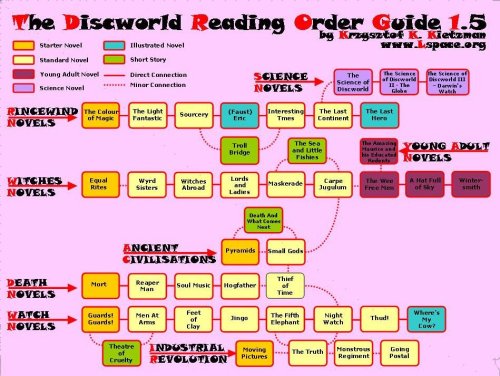
Guards! Guards! (I love writing out that title, I get to be so exclamatory) follows the mishaps and adventures of 4 nightwatch guardsmen who are, respectively, a Drunk, a Sleaze, a Blustery Coward, and a Definitely-Not-Long-Lost-King. When Dark Forces connive to infest the city with dragons, it's up to the aforementioned quartet to get to the bottom of the mystery. Really there's not a huge amount of story there, so I'll leave my summary at that to avoid spoilers.
Basically everything about this book was spot on. It had an interesting story that at first glance seemed predictable, but then turned out not to be. It had solid entertaining characters that actually *gasp!* developed via the plot line. It had excellent, witty dialog that got quite a number of chuckles out of me, particularly as many instances struck a Monty Python-esque chord with their pacing and delivery. Finally there was a healthy dose of intrigue, good guys in black, bad guys in white, clever and daring escapes, incredulous romances, and entertaining footnotes. Have I mentioned I'm a sucker for footnotes?
Anyway, the bottom line is a resounding thumbs up for this book - it's most certainly worth the read, and I know I'll be continuing to devour the rest of the books in this storyline. Seeing as how I'm nearly out of Dresden File books, I think these will serve nicely to break up other more serious fantasy.
Tuesday, November 13, 2007
Lisa's Take - Name of the Wind: Day One of The Kingkiller Chronicle (Patrick Rothfuss)
Looking back over the last month or so of reviews, there has been a whole lot of mediocre-to-negative. My review of The Blade Itself was particularly nasty - amusingly JD finds the dichotomy between my review of the book and the rating on amazon so great that he's decided to hold off on reading my review until he can digest the book for himself and see if it's really that bad, or if I let my knit picks get the better of me. Hopefully he'll come to similar conclusions and not take my credibility as a reviewer down -too- many notches.
Regardless, I decided that after so many bad reviews I'd better pick something I liked to review next. I thought about waiting until I finished Prachett's "Guards! Guards!" to write my next review (as that's basically guaranteed to be a glowing report) but then Pat Rothfuss friended me on Facebook and inspired me to get off my lazy toosh and write a review of Name of the Wind. Really this book deserved a review as soon as I finished it - but like I mentioned in the previous sentence, "Lazy Toosh." So, let me remedy that here.
Name of the Wind is a story told in the first person by an gentleman named Kvothe as he recounts his history and the events leading up to Some Mysterious Huge Thing that sent him into hiding in a remote, rarely frequented town. All in all, Kvothe recounts 14 or so years of his childhood in one day, thus how Name of the Wind is "Day One of the Kingkiller Chronicles." I'm not quite sure why, but I found this storytelling style very interesting, and it added a nice flare that helped spice up the story.
As for the story that Kvothe relates, it falls loosely into two categories: Kvothe's life before going to Magic School, and Kvothe's life at Magic School. I'm going to begin with my review of that second half, because as you might be able to guess from my (slightly belittling) terminology, that was my less favorite part of the book. Over all the book definitely gets a thumbs up, so I'd like to end it on an up note, rather than with criticism - thus let me get the bad out of the way early.
The trouble with the second half of this book (other than the fact that it dragged a bit) is that... it had all been done before. Many times. Especially if you've ever read Mercedes Lackey (who is kind of the gateway-drug into fantasy for teenage girls). Kvothe's story is just kind of the generic: kid goes to school and is so amazingly brilliant that even though he's young he excels everywhere, but of course there are both certain professors and students that have it out for him because he's so amazing. Unfairness and angst ensue interspersed with other accomplishments and triumphs. Heh, screw Mercedes Lackey - when I put it that way it kind of sounds like Ender's Game, too. Like I said, could have been a little more inspired. That said, the characterizations, dialog and interactions were very interesting, and the magic system original and intriguing. Also - the first half of the book was really excellent...
...So let me jump back to the beginning. The first half of the book is Kvothe relating his childhood before school. There was absolutely nothing hackneyed, predictable, or over-done about this part of the book. It was very fresh and interesting - not to mention I was very sympathetic to the characters very quickly. I had read maybe a couple of chapters before I turned to JD and said "Gah, this book is going to be trouble... I'm already emotionally involved." Particularly noteworthy was how incredibly well written Kvothe's parents were. I know - that's kind of an odd thing to comment on, but I think it might have been the most impressive thing about the book. I'm not sure I've ever read a happy pair of lovers done so damn well... it's just so easy to miss the mark when writing something to involved and emotional end delicate, but Patrick Rothfuss got it spot on. Also worth mentioning was the introduction of some intriguing and elusive Bad Guys, a fantastically developed Mentor, and the first peek into the interesting magic theory I mentioned above.
Really the bottom line here is this: over all, Name of the Wind is an excellent book. I had a gripe or two, but when it comes right down to it I very much enjoyed it, and I'm eagerly anticipating the sequel.
Regardless, I decided that after so many bad reviews I'd better pick something I liked to review next. I thought about waiting until I finished Prachett's "Guards! Guards!" to write my next review (as that's basically guaranteed to be a glowing report) but then Pat Rothfuss friended me on Facebook and inspired me to get off my lazy toosh and write a review of Name of the Wind. Really this book deserved a review as soon as I finished it - but like I mentioned in the previous sentence, "Lazy Toosh." So, let me remedy that here.
Name of the Wind is a story told in the first person by an gentleman named Kvothe as he recounts his history and the events leading up to Some Mysterious Huge Thing that sent him into hiding in a remote, rarely frequented town. All in all, Kvothe recounts 14 or so years of his childhood in one day, thus how Name of the Wind is "Day One of the Kingkiller Chronicles." I'm not quite sure why, but I found this storytelling style very interesting, and it added a nice flare that helped spice up the story.
As for the story that Kvothe relates, it falls loosely into two categories: Kvothe's life before going to Magic School, and Kvothe's life at Magic School. I'm going to begin with my review of that second half, because as you might be able to guess from my (slightly belittling) terminology, that was my less favorite part of the book. Over all the book definitely gets a thumbs up, so I'd like to end it on an up note, rather than with criticism - thus let me get the bad out of the way early.
The trouble with the second half of this book (other than the fact that it dragged a bit) is that... it had all been done before. Many times. Especially if you've ever read Mercedes Lackey (who is kind of the gateway-drug into fantasy for teenage girls). Kvothe's story is just kind of the generic: kid goes to school and is so amazingly brilliant that even though he's young he excels everywhere, but of course there are both certain professors and students that have it out for him because he's so amazing. Unfairness and angst ensue interspersed with other accomplishments and triumphs. Heh, screw Mercedes Lackey - when I put it that way it kind of sounds like Ender's Game, too. Like I said, could have been a little more inspired. That said, the characterizations, dialog and interactions were very interesting, and the magic system original and intriguing. Also - the first half of the book was really excellent...
...So let me jump back to the beginning. The first half of the book is Kvothe relating his childhood before school. There was absolutely nothing hackneyed, predictable, or over-done about this part of the book. It was very fresh and interesting - not to mention I was very sympathetic to the characters very quickly. I had read maybe a couple of chapters before I turned to JD and said "Gah, this book is going to be trouble... I'm already emotionally involved." Particularly noteworthy was how incredibly well written Kvothe's parents were. I know - that's kind of an odd thing to comment on, but I think it might have been the most impressive thing about the book. I'm not sure I've ever read a happy pair of lovers done so damn well... it's just so easy to miss the mark when writing something to involved and emotional end delicate, but Patrick Rothfuss got it spot on. Also worth mentioning was the introduction of some intriguing and elusive Bad Guys, a fantastically developed Mentor, and the first peek into the interesting magic theory I mentioned above.
Really the bottom line here is this: over all, Name of the Wind is an excellent book. I had a gripe or two, but when it comes right down to it I very much enjoyed it, and I'm eagerly anticipating the sequel.
Friday, November 09, 2007
Lisa's Take - The Blade Itself: First Law Book One (Joe Abercrombie)
Picture: A book with a cover that looks like worn, blood spattered parchment. Intriguing to say the least. Now imagine you pick up said Intriguing Tome and turn it over to see that the top comment is by Scott Lynch - who happens to be your Favorite Author Of The Moment. If you were Lisa in this situation you'd let out your patented "book squeal" (which is a hushed combination of a surprised utterance and thrilled giggling) and drop said book onto your (already alarmingly large) pile of books your about to purchase. If you have a JD present, he would at least have the presence of mind to read the back and flip the book open to check and make sure this is a Good Idea, but seeing a chapter entitled "Never Bet Against a Magus" would remove any lingering qualms.
This sounds ideal, yes?
Sadly, not so much. I'm afraid I've had my book choosing skills completely questioned to the point that I may never be able to select a new book without thorough research again. Okay, that's an exaggeration - but damn there could be no bigger let down than my self-imposed hype of this book compared to what it delivered. This is by far the most disappointing book I read this year - not only because I had such high hopes, but also just because it was Just Bad. Yes, with a capital J and B. I did something with this book that I haven't done since I read the first Wheel of Time book. When I read that one I dog-eared the bottom corner of every page that was a flagrant fantasy cliche or LoTR rip-off. This time around I dog-eared every page that had a plot or character inconsistency, PoV screwup, or bit of text that just made me laugh with incredulity. Yeah, it was that awful.
Let's start with the plot. I can't give you a plot summary, because, well... there wasn't really one. This book had no beginning, middle, and end. It was a mishmash of badly done, interleaved Point of View snippets that seemed to do a lot of... setting up, maybe? But they never really went anywhere. Even once the characters started converging there was just this sense of "yup, they sure did overlap. Didn't see -that- coming. No sir." There's a storyline following some unrest with the barbarians in the north. There's the escaped slave and overlord uprisings in the south. There's the country stuck in the middle that has some (laughable) political intrigue, a contest to Make A Champion (TM), and denial about impending wars. Finally there's a bit of Mandatory Magical Elements so that the book can officially qualify as fantasy. Eventually these plots interleave a bit. Mostly they just get told separately, and you can see the obvious and clearly defined ways in which they're going to impact each other.
Let's move on now to talk about the characters. Like I mentioned above, Mr. Abercrombie tried to write this book through character PoVs. He... did not pull this off well. He starts off with 3 major PoVs, then adds a 4th about half way through. That's ok. But then mixed in he (accidentally? I should hope not intentionally) would have random characters that had never had a PoV before pop in with a few pages or observations. That was badly done and made the whole plot setup feel very.... jumpy. Then, to make matters worse, in the second half of the book where characters stopped overlapping he did a fairly awful job of keeping PoVs well separated. At one point I had to stop and re-read a couple of pages because he jumped without warning from one PoV to another in the middle of some action and didn't make it clear, so I was left going "wait, why would he think that? He doesn't even know.... Oh." The worst part is that all of this could have been remedied with better editing. Someone needed to read this through and pay closer attention to "whose head we're currently in, where they are, what they know, and who they're interacting with."
Ok, PoV complaints are delineated. Now we can talk about character stereotypes, inconsistencies and cliches! I actually just made a list of all the characters I wanted to touch on, and it got a little lengthy. Forgive me for the places where I don't use names, many of them already escape me and I don't have the book immediately handy.
First we have our main PoV characters:
-Glokta of the 4 has the most potential to be interesting - he was the king's darling who was tortured and mutilated in the last war. Now he has a broken and rebellious body and works in the Inquisition as a Torturer because no other government branch will have him. He's at least marginally entertaining as he's one Jaded Motherfucker... unfortunately the whole Torturer thing feel like it's pulled route from Gene Wolfe's Book of the New Sun, which takes some of the creative shine off of it.
-Jezal is a military officer. He's an egotistical prick. He (predictably) subscribes to the Rich Common Belief that Poor People Without Noble Lineage shouldn't be allowed to be officers, and looks down on anyone who fits that bill appropriately. Oh, except that he then (predictably) falls in love with the commoner sister of his commander (where said commander got to be a commander by winning the Make A Champion (TM) contest mentioned above). He rails a lot against love but is (predictably) subject to that Cruel Mistress' whims. Oh, he's training to win this year's Make A Chamption (TM) contest to make his father proud and win recognition.
-Logen is a Northern Brute of a man. He was a champion in the north and has seen many battles, as the scars that disfigure his face and body prove. But underneath that brutish exterior is a tender and remorseful (but yet) intelligent and calculating mind.
-Ferro is an escaped slave who's out for VENGEANCE AGAINST THE WORLD! She's as mean and vicious as you could possibly imagine.
Next we have the two characters who aren't really PoV characters, but who have a couple of PoV moments erroneously snuck in:
-Major West: Jezal's commander. He was a commoner who won the Make A Champion Contest and won his command. Of course no one respects him, but he's a fine gentleman; enterprising, honorable, and of the highest moral values.
-Ardee West: West's younger sister who has no use for the pomp and rules of high society, and yet rails against the confines of being a commoner. Also she's made of past scandal, is a seducer of men and a huge lush. Of all the characters so far she manages to be at least mildly original and interesting. Too bad she's not a real PoV character.
-The Dogman became the leader of Logen's band when Logen was thought dead. The Dogman himself is interesting, but the rest of his crew is inconsistent - they are at first portrayed as the worst kind of scum, entirely without feelings or morality. Bad Men all around. But then they get going on this whole moral and honor thing... and it just doesn't quite grep.
Finally we have the non PoV characters
-Bayaz is every stereotype you've ever heard of a wizard (that doesn't look like a wizard). Does Teh Magicks, follows his own set of rules, is prone to hidden agendas and flashes of anger - all while trying to come off as a guiding and grandfatherly influence.
-As for the rest of the minor characters, there's the King who is slovenly and uninvolved, his sons of whom one follows the king's footsteps and one is of upstanding moral character, the princess betrothed who hates her fiance, the Higher Ups in The Inquisition who are cold and schemey, the King's aid who's trying to steal the throne out from under him, and the Dude who Jezal eventially fights in Make A Champion contest who is clearly a heartless brute but then gracefully concedes the win and even lifts Jezal up to the world!! Note that I went back and removed the 7 or so instances of "predictably" from the previous sentence. There is literally not a single character here that is unique, new, or inspired. There's ONE Inquisitor that has a few lines of involvement who entertained me for being cheerfully schemy, but he got depressingly little screen time.
I promise I'm not hyping up these descriptions (with the exception of a few "predictable" asides). They really are just that hackneyed. In a lot of the cases it's like he came up with a character and then went "that's to plain and overdone, let me spice it up!" But then in adding that spice just made the character that much more cliched. Then top everything off with a healthy dose of "not sticking to the characterization I put forth" and... there's not much salvaging to be done.
That wraps up the character gripes, the plot gripes, and the consistency gripes - but I have one more thing to complain about. This is actually the first problem I had with the book, before all the other flaws came to light. It's silly but it bugged me a lot, right from the beginning. All of Mr. Abercrombie's characters "speak" their guttural utterances. "Aaaaargh!" or "Oof!" or "Uh." or "Er..." are very common conversational lines. Now, there are cases in which this sort of dialog can be humorous - for instance when Jezal has his first conversation with Ardee and she's commenting on his (not so) renowned wit - and all he can come up with for a reply is "Er..." That situation's ok and if it's done just right can even be amusing. But when some dude is getting tortured and you're obviously trying to build a very intense, graphic and violent air to the scene? It's not appropriate to have him say "aaaargh!" after each torturous action. You might try "a hoarse shout of pain" or perhaps a "bloody gurgling cough" but "aaaargh!" over and over just doesn't cut it unless you're specifically trying to go for comic relief. Who knows, maybe if this first little knit-pick hadn't set me on edge I wouldn't have been so hard on the rest of the book... but then again, maybe not.
Well, with all of that text I hardly feel like I need a closing paragraph, but I suppose in good form I should wrap things up explicitly. Don't waste your money on this book. Don't waste the effort required to borrow it from me, or the brain power necessary to slog your way through it. Hell, probably just reading this review was more time than you ever needed to dedicate to The Blade Itself. Really any good, dedicated fantasy reader would skip this review all together and dedicate the 15 minutes you save to emailing Scott Lynch and ask him why he so maliciously deceived me. I suppose I should have thought of that an hour ago!
This sounds ideal, yes?
Sadly, not so much. I'm afraid I've had my book choosing skills completely questioned to the point that I may never be able to select a new book without thorough research again. Okay, that's an exaggeration - but damn there could be no bigger let down than my self-imposed hype of this book compared to what it delivered. This is by far the most disappointing book I read this year - not only because I had such high hopes, but also just because it was Just Bad. Yes, with a capital J and B. I did something with this book that I haven't done since I read the first Wheel of Time book. When I read that one I dog-eared the bottom corner of every page that was a flagrant fantasy cliche or LoTR rip-off. This time around I dog-eared every page that had a plot or character inconsistency, PoV screwup, or bit of text that just made me laugh with incredulity. Yeah, it was that awful.
Let's start with the plot. I can't give you a plot summary, because, well... there wasn't really one. This book had no beginning, middle, and end. It was a mishmash of badly done, interleaved Point of View snippets that seemed to do a lot of... setting up, maybe? But they never really went anywhere. Even once the characters started converging there was just this sense of "yup, they sure did overlap. Didn't see -that- coming. No sir." There's a storyline following some unrest with the barbarians in the north. There's the escaped slave and overlord uprisings in the south. There's the country stuck in the middle that has some (laughable) political intrigue, a contest to Make A Champion (TM), and denial about impending wars. Finally there's a bit of Mandatory Magical Elements so that the book can officially qualify as fantasy. Eventually these plots interleave a bit. Mostly they just get told separately, and you can see the obvious and clearly defined ways in which they're going to impact each other.
Let's move on now to talk about the characters. Like I mentioned above, Mr. Abercrombie tried to write this book through character PoVs. He... did not pull this off well. He starts off with 3 major PoVs, then adds a 4th about half way through. That's ok. But then mixed in he (accidentally? I should hope not intentionally) would have random characters that had never had a PoV before pop in with a few pages or observations. That was badly done and made the whole plot setup feel very.... jumpy. Then, to make matters worse, in the second half of the book where characters stopped overlapping he did a fairly awful job of keeping PoVs well separated. At one point I had to stop and re-read a couple of pages because he jumped without warning from one PoV to another in the middle of some action and didn't make it clear, so I was left going "wait, why would he think that? He doesn't even know.... Oh." The worst part is that all of this could have been remedied with better editing. Someone needed to read this through and pay closer attention to "whose head we're currently in, where they are, what they know, and who they're interacting with."
Ok, PoV complaints are delineated. Now we can talk about character stereotypes, inconsistencies and cliches! I actually just made a list of all the characters I wanted to touch on, and it got a little lengthy. Forgive me for the places where I don't use names, many of them already escape me and I don't have the book immediately handy.
First we have our main PoV characters:
-Glokta of the 4 has the most potential to be interesting - he was the king's darling who was tortured and mutilated in the last war. Now he has a broken and rebellious body and works in the Inquisition as a Torturer because no other government branch will have him. He's at least marginally entertaining as he's one Jaded Motherfucker... unfortunately the whole Torturer thing feel like it's pulled route from Gene Wolfe's Book of the New Sun, which takes some of the creative shine off of it.
-Jezal is a military officer. He's an egotistical prick. He (predictably) subscribes to the Rich Common Belief that Poor People Without Noble Lineage shouldn't be allowed to be officers, and looks down on anyone who fits that bill appropriately. Oh, except that he then (predictably) falls in love with the commoner sister of his commander (where said commander got to be a commander by winning the Make A Champion (TM) contest mentioned above). He rails a lot against love but is (predictably) subject to that Cruel Mistress' whims. Oh, he's training to win this year's Make A Chamption (TM) contest to make his father proud and win recognition.
-Logen is a Northern Brute of a man. He was a champion in the north and has seen many battles, as the scars that disfigure his face and body prove. But underneath that brutish exterior is a tender and remorseful (but yet) intelligent and calculating mind.
-Ferro is an escaped slave who's out for VENGEANCE AGAINST THE WORLD! She's as mean and vicious as you could possibly imagine.
Next we have the two characters who aren't really PoV characters, but who have a couple of PoV moments erroneously snuck in:
-Major West: Jezal's commander. He was a commoner who won the Make A Champion Contest and won his command. Of course no one respects him, but he's a fine gentleman; enterprising, honorable, and of the highest moral values.
-Ardee West: West's younger sister who has no use for the pomp and rules of high society, and yet rails against the confines of being a commoner. Also she's made of past scandal, is a seducer of men and a huge lush. Of all the characters so far she manages to be at least mildly original and interesting. Too bad she's not a real PoV character.
-The Dogman became the leader of Logen's band when Logen was thought dead. The Dogman himself is interesting, but the rest of his crew is inconsistent - they are at first portrayed as the worst kind of scum, entirely without feelings or morality. Bad Men all around. But then they get going on this whole moral and honor thing... and it just doesn't quite grep.
Finally we have the non PoV characters
-Bayaz is every stereotype you've ever heard of a wizard (that doesn't look like a wizard). Does Teh Magicks, follows his own set of rules, is prone to hidden agendas and flashes of anger - all while trying to come off as a guiding and grandfatherly influence.
-As for the rest of the minor characters, there's the King who is slovenly and uninvolved, his sons of whom one follows the king's footsteps and one is of upstanding moral character, the princess betrothed who hates her fiance, the Higher Ups in The Inquisition who are cold and schemey, the King's aid who's trying to steal the throne out from under him, and the Dude who Jezal eventially fights in Make A Champion contest who is clearly a heartless brute but then gracefully concedes the win and even lifts Jezal up to the world!! Note that I went back and removed the 7 or so instances of "predictably" from the previous sentence. There is literally not a single character here that is unique, new, or inspired. There's ONE Inquisitor that has a few lines of involvement who entertained me for being cheerfully schemy, but he got depressingly little screen time.
I promise I'm not hyping up these descriptions (with the exception of a few "predictable" asides). They really are just that hackneyed. In a lot of the cases it's like he came up with a character and then went "that's to plain and overdone, let me spice it up!" But then in adding that spice just made the character that much more cliched. Then top everything off with a healthy dose of "not sticking to the characterization I put forth" and... there's not much salvaging to be done.
That wraps up the character gripes, the plot gripes, and the consistency gripes - but I have one more thing to complain about. This is actually the first problem I had with the book, before all the other flaws came to light. It's silly but it bugged me a lot, right from the beginning. All of Mr. Abercrombie's characters "speak" their guttural utterances. "Aaaaargh!" or "Oof!" or "Uh." or "Er..." are very common conversational lines. Now, there are cases in which this sort of dialog can be humorous - for instance when Jezal has his first conversation with Ardee and she's commenting on his (not so) renowned wit - and all he can come up with for a reply is "Er..." That situation's ok and if it's done just right can even be amusing. But when some dude is getting tortured and you're obviously trying to build a very intense, graphic and violent air to the scene? It's not appropriate to have him say "aaaargh!" after each torturous action. You might try "a hoarse shout of pain" or perhaps a "bloody gurgling cough" but "aaaargh!" over and over just doesn't cut it unless you're specifically trying to go for comic relief. Who knows, maybe if this first little knit-pick hadn't set me on edge I wouldn't have been so hard on the rest of the book... but then again, maybe not.
Well, with all of that text I hardly feel like I need a closing paragraph, but I suppose in good form I should wrap things up explicitly. Don't waste your money on this book. Don't waste the effort required to borrow it from me, or the brain power necessary to slog your way through it. Hell, probably just reading this review was more time than you ever needed to dedicate to The Blade Itself. Really any good, dedicated fantasy reader would skip this review all together and dedicate the 15 minutes you save to emailing Scott Lynch and ask him why he so maliciously deceived me. I suppose I should have thought of that an hour ago!
Monday, October 22, 2007
Lisa's Take: The Black Jewels Trilogy (Anne Bishop)
(In a clucking tone of voice) TRIIIIIPE tripetripetripetripe. Tripe.
By all that's holy, I really don't know how I finished this trilogy of books. I think perhaps it was only for the feeling of conquest that comes with completing an exceptionally thick volume - which this certainly qualified as, with the trilogy bound into one book. Surely there were some redeeming features to be had, but I'm having the worst time calling them to mind now. When you get right down to it the prose was dull and uninspired, the characters didn't even approach anything resembling original, compelling or consistent, and the plot tried SO hard to be full on intrigue, emotion, and convolutions... but was really just straightforward and predictable. Also made of holes. Perhaps the only thing I can say for the books is that the universe and premise behind it was original and at least marginally interesting. If I stretch really hard there might have been 3 lines of dialog that got something resembling a chuckle out of me. At least said dull and uninspired prose was digestible enough to keep the words flowing. That's as much praise as I can manage.
This is the part where I classically would type "That said, you might still consider this book if...." but no. Not this time. Maybe, MAYBE if you're a 16 year old girl who reads nothing but Mercedes Lackey or Laurell K. Hamilton you might find this trilogy worthwhile. Personally, I can muster nothing but scorn and scathing words, so I will leave this review laconic - which is to say, I will end it right here. How's that for a bad review of a bad book?
By all that's holy, I really don't know how I finished this trilogy of books. I think perhaps it was only for the feeling of conquest that comes with completing an exceptionally thick volume - which this certainly qualified as, with the trilogy bound into one book. Surely there were some redeeming features to be had, but I'm having the worst time calling them to mind now. When you get right down to it the prose was dull and uninspired, the characters didn't even approach anything resembling original, compelling or consistent, and the plot tried SO hard to be full on intrigue, emotion, and convolutions... but was really just straightforward and predictable. Also made of holes. Perhaps the only thing I can say for the books is that the universe and premise behind it was original and at least marginally interesting. If I stretch really hard there might have been 3 lines of dialog that got something resembling a chuckle out of me. At least said dull and uninspired prose was digestible enough to keep the words flowing. That's as much praise as I can manage.
This is the part where I classically would type "That said, you might still consider this book if...." but no. Not this time. Maybe, MAYBE if you're a 16 year old girl who reads nothing but Mercedes Lackey or Laurell K. Hamilton you might find this trilogy worthwhile. Personally, I can muster nothing but scorn and scathing words, so I will leave this review laconic - which is to say, I will end it right here. How's that for a bad review of a bad book?
Lisa's Take: The Kite Runner by Khaled Hosseini
I know, this is an odd break from my usual diet of fantasy, sci-fi, fantasy, and more fantasy, isn't it? I blame boredom - I was stuck immobile while a few other people investigated a corn maze, so I rooted around in their supply of satchels and purses until I came across something to keep me entertained. I found The Kite Runner, which I had no idea was such a well known and acclaimed work (movie is in production, and held up with all sorts of controversy). Shows how much attention I pay to the Straight Fiction Genre as a whole.
Anyway, I can understand how The Kite Runner has garnered so much acclaim. It's one of those books that... pretty much can't help but get good reviews and recognition, much like any movie about (for instance) 9-11. The problem is that I can't decide whether it's only good because it's so startling, or if it's actually good in its own right. I suppose I'll start with a quick summary and then go from there.
Kite runner is a story about a man named Amir. The plot follows him through his childhood, cataloging the betrayals he perpetrates and the path that his life follows afterwards as he comes to grip with living as a coward and eventually seeks redemption. It begins in Afghanistan in the 70s and the political unrest there is both a reflection and a backdrop for the whole story.
That's a fairly paltry summary, but to be honest there's just not -that- much content I can summarize without getting spoilerific, so I'll leave it at that. The day I picked up Kite Runner I read about 40 pages, and it was good enough to keep me hooked and legitimately borrow the book. The images it evoked were both clear an engaging, and I found myself quite drawn into the image the author painted of childhood in the summer. Of course this just made the impending turning of the plot for the worse that much more painful - I was in quite an awful mood the day the book got depressing, and it was really very effecting.
That said, the author did a few things that really prodded my pet-peeve button and did a lot to detract from the story. Gripe number one was the constant and flagrant overuse of "Little did he know." It wasn't always phrased that way, but I swear to god if I had to hear the main character say "I didn't know then, but..." one more time, I was going to punch someone. Gripe number two was that the whole thing was just too... tidy. Not in the literal sense (as there was violence and gore enough to offend even the most staunch sensibilities) but in the sense that everything just sort of worked out and fit together juuuuust so. Old childhood nemesis cropping up at exactly the expected moment, that sort of thing. While the first half of the book pretty much took me, if not by surprise, without a sense of "oh, here it comes," the second half of the book was just one instance after another of "ah, I see, now this is going to happen, and then that, and the timing will go just so." Right at the very end I thought the author might shake things up and tarnish the obvious perfection that was impending... but, he didn't. Not really.
That said - The Kite Runner is still one of those books that can't get bad reviews. It's well written enough that you can get over it's faults, glaring though they are to any but the most pedestrian of readers, and the story and events in it are controversial enough that you can't bad mouth them without being called an ass. What a way to gain acclaim! I guess in the end I'll say it's a good book - but it certainly gets a lot more credit than it's truly due. Still, it's worth the read.
Anyway, I can understand how The Kite Runner has garnered so much acclaim. It's one of those books that... pretty much can't help but get good reviews and recognition, much like any movie about (for instance) 9-11. The problem is that I can't decide whether it's only good because it's so startling, or if it's actually good in its own right. I suppose I'll start with a quick summary and then go from there.
Kite runner is a story about a man named Amir. The plot follows him through his childhood, cataloging the betrayals he perpetrates and the path that his life follows afterwards as he comes to grip with living as a coward and eventually seeks redemption. It begins in Afghanistan in the 70s and the political unrest there is both a reflection and a backdrop for the whole story.
That's a fairly paltry summary, but to be honest there's just not -that- much content I can summarize without getting spoilerific, so I'll leave it at that. The day I picked up Kite Runner I read about 40 pages, and it was good enough to keep me hooked and legitimately borrow the book. The images it evoked were both clear an engaging, and I found myself quite drawn into the image the author painted of childhood in the summer. Of course this just made the impending turning of the plot for the worse that much more painful - I was in quite an awful mood the day the book got depressing, and it was really very effecting.
That said, the author did a few things that really prodded my pet-peeve button and did a lot to detract from the story. Gripe number one was the constant and flagrant overuse of "Little did he know." It wasn't always phrased that way, but I swear to god if I had to hear the main character say "I didn't know then, but..." one more time, I was going to punch someone. Gripe number two was that the whole thing was just too... tidy. Not in the literal sense (as there was violence and gore enough to offend even the most staunch sensibilities) but in the sense that everything just sort of worked out and fit together juuuuust so. Old childhood nemesis cropping up at exactly the expected moment, that sort of thing. While the first half of the book pretty much took me, if not by surprise, without a sense of "oh, here it comes," the second half of the book was just one instance after another of "ah, I see, now this is going to happen, and then that, and the timing will go just so." Right at the very end I thought the author might shake things up and tarnish the obvious perfection that was impending... but, he didn't. Not really.
That said - The Kite Runner is still one of those books that can't get bad reviews. It's well written enough that you can get over it's faults, glaring though they are to any but the most pedestrian of readers, and the story and events in it are controversial enough that you can't bad mouth them without being called an ass. What a way to gain acclaim! I guess in the end I'll say it's a good book - but it certainly gets a lot more credit than it's truly due. Still, it's worth the read.
Monday, October 08, 2007
Lisa’s Take – Vellum (Hal Duncan)
There is, perhaps, nothing in the world more infuriating than a book that could just almost be absolutely incredible… but, rather than pull through and be remarkable, manages instead to be awful, painful, and frustrating. Vellum is the first book I’ve ever read that quite fits this bill, truth be told – the occasional novel might be dull with brilliant flashes, or excellent with bad aspects that bring it down, but nothing quite like this. For my first trick, I will attempt a plot summary. I’m wildly torn between saying that there’s just too much to summarize, that the paths and meanderings of the text are too divergent to condense into a few sentences… versus saying that there’s not enough there to make a summary out of – the story too thin, the characters too inconsistent. Still, I’ll try.
I could go on with the ranting, but I’ll desist before I get incoherent in my frustration. The bottom line? Reading Vellum was thoroughly infuriating and unenjoyable… and then just to ice the cake there’s no end, no winding down – the book just stops, presumably so that the sequel (Ink) can pick up. Too bad that I won’t be picking it up.
Thursday, September 20, 2007
JD's Take: Homeland (R. A. Salvadore)
I've been wrestling for months with the desire to read cheap, pulpy, horrid, serialized fantasy or science fiction. Based on someone else's intellectual property if at all possible. I finally caved when I discovered a copy of Homeland by the oft-reviled R.A. Salvatore sitting on our shelves looking forlorn.
For those of you unfamiliar with this little piece of geek history, this book was the introduction of the character Drizzt. Still nothing? Okay, fine. Drizzt is a Drow Elf (or dark elf. The evil kind) who has a Good Heart, Two Scimitars, and a Pet Leopard. He rebels against the evil society he is brought up in (aided by the fact that he is So Much Cooler than anybody else) and becomes a great hero of the world. Sound like a hackneyed backstory from roleplaying session? An overused D&D cliche? It is, and this book is the reason for that.
So. I read it. Let me just give you a couple of impressions.
1) The spine of the book does *not* list the author of the book. There isn't room. See they needed the title, the name of the story cycle (The Dark Elf Trilogy. Very catchy) the book number (1!) and of course... the Forgotten Realms logo. Oh, and the TSR logo. And the publisher's logo.
2) So near the end of the first or second chapter I was forced to stop and step back from the book. On the two page spread I was looking at, 11 out of 14 paragraphs started with the word 'Zak'. Seriously. That's some quality writing.
3) The word Drow is *never* used without being followed by the word Elf or Elves. That's at least once a page, and never is it used by itself. It's absurd. Surely by page 50 I've figured out that the Drow are a kind of elf!
4) The Drow are Chaotic as a race. Which explains their rigidly lawful theocracy. Actually, I can't blame this one on Salvatore... stupid TSR.
Having said that, I almost wrote "but it's still a fun read" out of habit. But it really isn't. The basic plot arc is Drizzt is born --> Drizzt grows up to be a Hardcore Badass who excels at everything he touches and has a heart of pure gold --> Drizzt leaves the city with his pet Leopard. At no point do you doubt his safety. His mentor dies (oh shits! Spoiler) which any reader could have predicted at page 30. He is dutifully sad/enraged. His rivals fall before him (but he feels bad about it) and he leaves because he refused to conform to the evil ways of the evil society of his evil race. His sense of Good and Honor blossom despite the fact that he was at NO POINT exposed to these ideas.
Spare me. The good news is, it's a quick read. And you can't pick up this novel with high expectations, so you aren't likely to be terribly disappointed. That's about all the good I can wring from it. I'd read more but I'm pretty certain I get the gist of the REST OF HIS LIFE. For fun, I'll predict some key events:
I wonder if Alien fiction is any better? Or maybe Warhammer?
For those of you unfamiliar with this little piece of geek history, this book was the introduction of the character Drizzt. Still nothing? Okay, fine. Drizzt is a Drow Elf (or dark elf. The evil kind) who has a Good Heart, Two Scimitars, and a Pet Leopard. He rebels against the evil society he is brought up in (aided by the fact that he is So Much Cooler than anybody else) and becomes a great hero of the world. Sound like a hackneyed backstory from roleplaying session? An overused D&D cliche? It is, and this book is the reason for that.
So. I read it. Let me just give you a couple of impressions.
1) The spine of the book does *not* list the author of the book. There isn't room. See they needed the title, the name of the story cycle (The Dark Elf Trilogy. Very catchy) the book number (1!) and of course... the Forgotten Realms logo. Oh, and the TSR logo. And the publisher's logo.
2) So near the end of the first or second chapter I was forced to stop and step back from the book. On the two page spread I was looking at, 11 out of 14 paragraphs started with the word 'Zak'. Seriously. That's some quality writing.
3) The word Drow is *never* used without being followed by the word Elf or Elves. That's at least once a page, and never is it used by itself. It's absurd. Surely by page 50 I've figured out that the Drow are a kind of elf!
4) The Drow are Chaotic as a race. Which explains their rigidly lawful theocracy. Actually, I can't blame this one on Salvatore... stupid TSR.
Having said that, I almost wrote "but it's still a fun read" out of habit. But it really isn't. The basic plot arc is Drizzt is born --> Drizzt grows up to be a Hardcore Badass who excels at everything he touches and has a heart of pure gold --> Drizzt leaves the city with his pet Leopard. At no point do you doubt his safety. His mentor dies (oh shits! Spoiler) which any reader could have predicted at page 30. He is dutifully sad/enraged. His rivals fall before him (but he feels bad about it) and he leaves because he refused to conform to the evil ways of the evil society of his evil race. His sense of Good and Honor blossom despite the fact that he was at NO POINT exposed to these ideas.
Spare me. The good news is, it's a quick read. And you can't pick up this novel with high expectations, so you aren't likely to be terribly disappointed. That's about all the good I can wring from it. I'd read more but I'm pretty certain I get the gist of the REST OF HIS LIFE. For fun, I'll predict some key events:
- Drizzt meets other elves. Turns out, They Aren't Evil.
- Drizzt is outcast (oh! the title of the second book!) from Good society because of racism! Racism is bad!
- Drizzt is framed for the vicious murder of a school filled with orphans, which he was only trying to protect! Poor Drizzt!
- Drizzt gains the respect of the Elven Community!
- Drizzt kills Lloth, the spider-queen-god of the Drow Elves
- Drizzt, his Pet Leopard, and his New Girlfriend(I'm guessing a wood cleric)/Brother In Arms (a nobleman on a quest of self discovery. Probably a wizard/fighter) die bravely in battle. But they get better. Repeatedly (This happened (twice) to the damn cat in the first book alone!).
- Drizzt mournfully sees the downfall of his race. He is very conflicted about it.
- Actually, Drizzt spends an unhealthy amount of time feeling sorry for himself. Then he kills shit and it makes him feel better. Or sets off the next bout of self-loathing.
I wonder if Alien fiction is any better? Or maybe Warhammer?
Lisa's Take: Gil's All Fright Diner (A. Lee Martinez)
I’d like to start this review by noting that I typoed Mr. Martinez’s name twice as A. Leet Martinez. This mistake can certainly be attributed to the fact that’s he’s one hell of an awesome dude, as much as it can be blamed on my slow and under-caffeinated fingers. But that’s neither here nor there, I suppose…
Finally, I’d like to make a quick note of my Great Approval for authors that release a book every year. A good book, at that. Authors whose names are subsets of Mr. Martinez’s could learn a thing or two about this. And now go! Make for the Leet reading!
Subscribe to:
Posts (Atom)